
Anyone asking is parchment paper air fryer safe usually wants to know two things: will it catch fire, and is it releasing anything into my food.
Parchment paper is safe to use in an air fryer as long as you add it after preheating, weigh it down with food, keep it below its heat rating (typically 420 to 450°F), and cut it smaller than the basket so airflow isn’t blocked.
A loose or unweighted sheet can lift into the heating element and catch fire. The bigger question most safety articles skip is what’s actually in the paper, and that’s the second half of the answer.
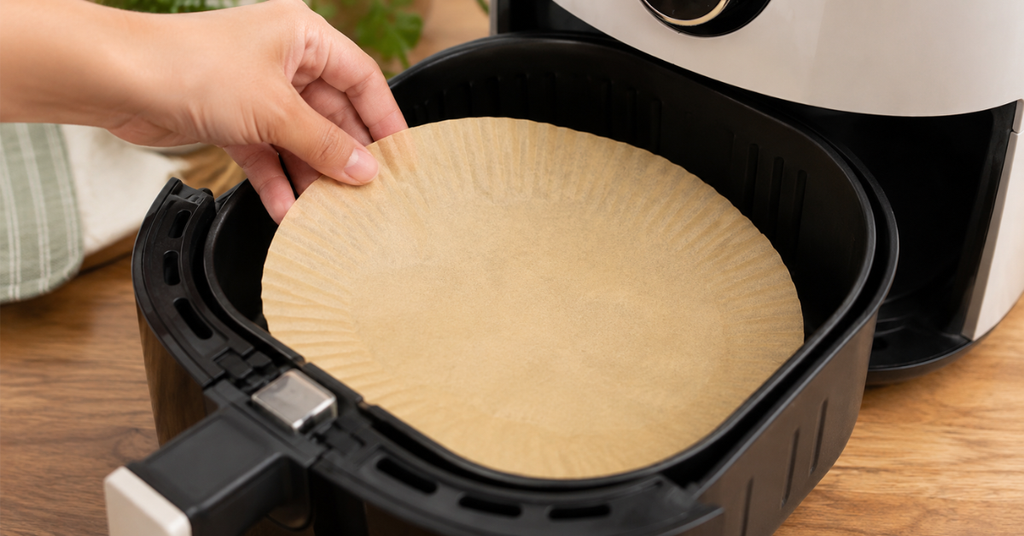
I use parchment paper in my own air fryer most weeks, and the first time a sheet lifted and got pulled sharply toward the heating element, I understood exactly why you’re reading this.
What’s kept me curious since then is the quieter question: what is this paper actually made of, and is the heat pulling something out of it and into my food? Both answers are here.
Key Takeaways
- Parchment paper is safe in an air fryer when added after preheating, weighed down with food, cut smaller than the basket, and used below its heat rating (usually 420 to 450°F).
- The real hazard is the fan, not the heat: an unweighted sheet can lift into the heating element and start a fire.
- What’s in the paper matters as much as how you use it. Choose unbleached, silicone-coated (not Quilon), and PFAS-tested where possible.
- A reusable silicone air fryer liner is the eco alternative to disposables and pays for itself in about 15 uses.
The Short Answer: Is Parchment Paper Safe in an Air Fryer?
Yes, parchment paper is safe in an air fryer when it is added after preheating, weighed down with food, kept below its heat rating, and cut smaller than the basket so hot air can circulate.
That is the entire safety picture on the fire side, and it’s the piece the featured snippet is asking for.
Here is the 5-rule cheat sheet at a glance:
- Preheat empty. Add the paper with the food, never before.
- Weigh it down. Food should cover at least two-thirds of the sheet.
- Cut it smaller than the basket. Never let it climb the sides.
- Use perforated sheets (or pre-punched liners) so the fan can move air through.
- Check the heat rating on the box and stay under it.
Each rule has a reason behind it, and I’ll walk through those in the next two sections.
What Actually Happens When Parchment Meets an Air Fryer
The real hazard is not the heat, it is the air fryer’s high-velocity fan, which can lift an unweighted sheet of parchment into the heating element and start a fire. That’s the sentence to keep in mind for the rest of this article.
A food editor at Country Living’s test kitchen ran the experiment most of us should never try: setting an air fryer to 400°F with a bare sheet of parchment in the basket to see what would happen.
The result, as Christopher Michel documented for Country Living, was exactly what you’d expect once you understand the mechanism.
An air fryer is a small convection oven with a high-velocity fan. Parchment paper is silicone-coated, oven-rated non-stick paper (and it is not the same thing as wax paper, which has a paraffin coating that melts and smokes at these temperatures).
Most parchment is rated to 420 to 450°F, and most air fryers cap at 400°F, so temperature alone is rarely what causes the problem. The fan is.
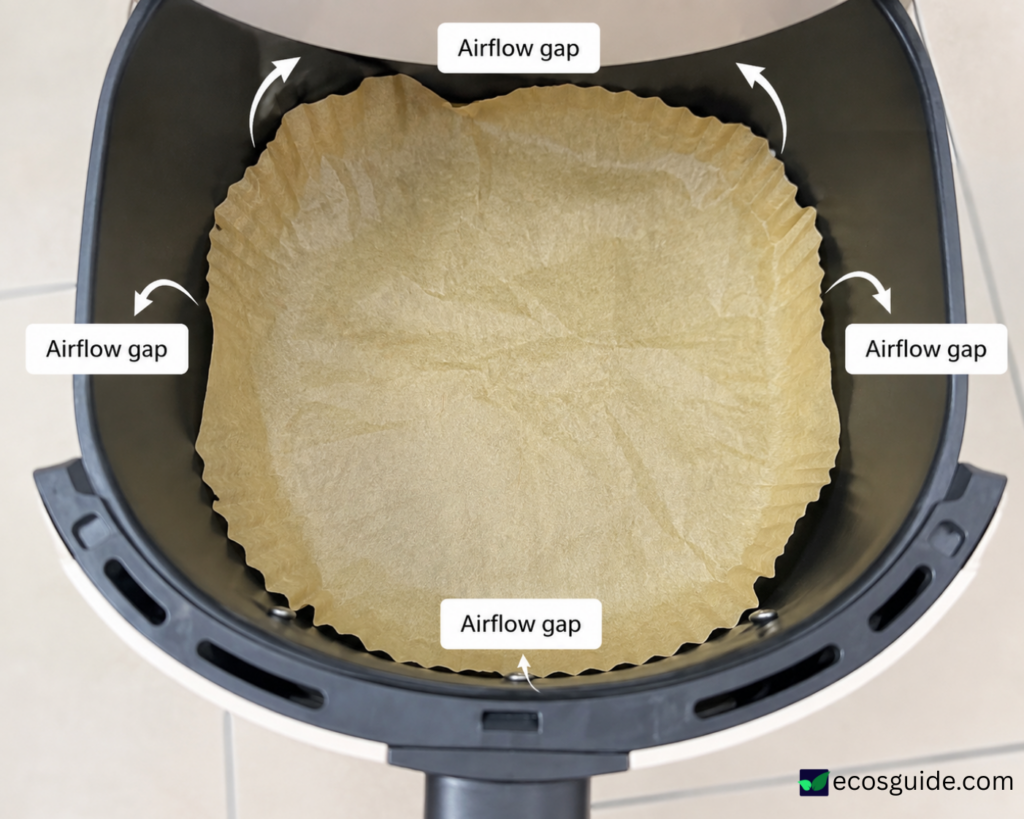
That’s also where a second issue quietly shows up: airflow. Consumer Reports test engineer Larry Ciufo, who oversees the publication’s air fryer testing, told CR that a solid sheet of parchment can block roughly 99% of an air fryer’s airflow.
Even when nothing catches fire, the food comes out steamed instead of crisp. I’ve watched a sheet lift in my own fryer, and once you have, you don’t forget which mistake caused it.
The 5 Rules for Using Parchment Paper Safely in an Air Fryer
1. Preheat empty. Add the parchment with the food, never before.
Never preheat an air fryer with parchment paper alone in the basket. Add the parchment sheet at the same time you add the food, so the food’s weight holds the paper flat from the first second of cooking.
Preheating with a bare sheet is the single most common cause of parchment fires.
2. Weigh it down. Food should cover at least two-thirds of the sheet.
A half-loaded sheet is a half-lifted sheet by the time the fan spins up. Bulky, dense foods (chicken thighs, potato wedges, thick fish fillets) hold the paper down reliably.
Loose small snacks like popcorn, small cookies, or a single portion of something light are the highest-risk load.
3. Cut it smaller than the basket. Never let it climb the sides.
The paper should sit flat on the basket floor with no edges creeping up the walls or overhanging the rim.
Edges that touch the heating element or ride the airflow are what catches fire in almost every burn-test video online.
4. Use perforated paper, or use pre-punched liners.
Solid sheets block airflow (that’s the 99% figure from the Consumer Reports finding above) and give you soggy food.
Pre-perforated liners let hot air circulate underneath, which is why food comes out crispier and why the paper is less likely to lift.
5. Check the heat rating on the box and stay under it.
Most plain parchment is rated 420 to 450°F. Most air fryers cap at 400°F, so heat is rarely the issue, unless you’re using a printed “air fryer liner” product that’s rated lower.
Reynolds’ own air fryer liners, for example, are heat-safe only to 400°F on the air fry setting, not the 425 to 450°F standard for plain parchment.
The Warning Most Articles Miss: Toaster-Oven-Style Air Fryers
Parchment paper is not recommended for rectangular or toaster oven-style air fryers, according to Reynolds Kitchens’ own liner guidance, because the heating element in those form factors is often positioned where a lifted sheet can reach it.
The models to watch for here are the rectangular ones people often own without realizing the form factor matters: rectangular Ninja Foodi variants, Instant Vortex Pro, Cuisinart TOA-series, and the taller COSORI models.
On those, the heating element usually sits closer to the top of the cooking chamber, and a lifted sheet has a much shorter distance to travel before making contact.
Reynolds Kitchens’ own air fryer liner how-to page states directly that its liners are not recommended for use in rectangular or toaster oven-style air fryers, and warns never to let a liner directly contact the heating element of any air fryer.
If you own one of these models, a reusable silicone liner (or no liner at all, which I cover further down) is the safer choice.
What They Don’t Tell You: The Coating and PFAS Question
The fire question is only half the safety question. The other half is what’s leaching out of the paper and into the food.
This is the part I fell down the rabbit hole on: what is parchment paper actually made of, and is the heat doing anything to it I should care about?
The safest parchment paper for an air fryer is unbleached, silicone-coated (not Quilon-coated), and third-party tested for PFAS “forever chemicals.”
Bleached parchment can carry dioxin residues from chlorine processing, and Quilon coatings contain chromium.
Silicone vs Quilon: The Two Coatings Most Readers Don’t Know About
All parchment paper is coated to make it non-stick.
Two coatings dominate the market: silicone, the modern health-focused-brand standard, and Quilon, an older and cheaper alternative that uses a chromium(III) compound.
Silicone is broadly regulator-recognized as food-safe. Quilon still has legal food-contact use in the US, but it’s increasingly avoided by health-focused brands.
The honest framing is: silicone is the modern standard, Quilon is the older, cheaper alternative.
The practical catch is that most parchment boxes don’t say “silicone-coated” on the front, and if it isn’t stated, it’s usually Quilon. Health-focused brands (If You Care, Katbite, King Arthur) do state silicone explicitly.
Bleached vs Unbleached: The Chlorine Question
Bleached parchment (the white version) is processed with chlorine, which can leave dioxin residues.
Unbleached parchment (the brown version) skips the chlorine step entirely. There is no cooking-performance advantage to bleached parchment, and unbleached is the health-and-eco default for anyone who has a choice.
PFAS “Forever Chemicals” and the FDA’s February 2024 Rule Change
On February 28, 2024, the FDA announced that grease-proofing substances containing PFAS are no longer being sold for food-contact use in the US market.
That doesn’t automatically mean every parchment brand on your grocery shelf is PFAS-free today. New stock shouldn’t contain them, but older stock may still be in circulation, and PFAS can also show up as background contamination in manufacturing.
This is where Mamavation’s independent PFAS testing is useful. Leah Segedie (dubbed “The PFAS Hunter” by Consumer Reports) commissioned an EPA-certified lab to test popular parchment brands for total organic fluorine as a proxy for PFAS. The results:
| Brand | Total fluorine result | Coating |
| If You Care Parchment Baking Paper (roll) | Non-detect at 10 ppm | Silicone (unbleached, FSC-certified) |
| If You Care Baking Sheets | Non-detect at 10 ppm | Silicone (pre-cut) |
| Katbite Unbleached Parchment | Non-detect at 10 ppm | Silicone |
| GIFBERA Unbleached | Non-detect at 10 ppm | Silicone |
| Biocean Parchment | 12 ppm | Silicone |
| Kirkland (Costco) | 12 ppm | Not stated |
| Reynolds Parchment | 12 ppm | Not stated |
Testing conducted by Mamavation with an EPA-certified lab. Results reflect total organic fluorine as a proxy for PFAS. Mamavation uses “non-detect at 10 ppm” rather than “PFAS-free” because the lab’s level of detection was 9 to 10 ppm.
What to Look for on the Box
If you want a scannable buying checklist:
- Unbleached (brown, not white)
- Silicone-coated (stated on the box; if it isn’t stated, assume Quilon)
- PFAS-tested or third-party lab result available (bonus signal)
- FSC-certified paper (bonus eco signal)
When You Should NOT Use Parchment Paper in Your Air Fryer
The rules above tell you how to use parchment safely. There are also five situations where the honest answer is: skip it entirely.
Parchment paper should not be used in an air fryer during preheating, with foods too light to hold it down, at temperatures above the paper’s heat rating, or in toaster-oven-style air fryers where the heating element sits close to the basket.
- When you want maximum crispiness.
Direct basket contact wins for fries, breaded chicken, wings, and anything you don’t want soggy. The mesh airflow is doing real work.
- When the food is too light to weigh the paper down.
Small cookies, popcorn, single-portion snacks (anything under a couple of ounces) cannot reliably hold the sheet flat.
- When your recipe exceeds 425°F.
Rare in air fryer cooking, but check the heat rating on the box against the recipe temperature.
- When you’re preheating.
The paper goes in with the food, never before. This is Rule 1 restated, and it’s the mistake people make most often, so it’s worth naming twice.
- In toaster-oven-style air fryers.
Per Reynolds’ own liner guidance, and covered in detail above.
A Better Question: Do You Even Need Parchment Paper?
The fire question and the coating question both assume you’ve already decided to use a liner. Sometimes the right answer is not to.
Every disposable liner is a decision made 100 times over the life of one roll. I don’t think about that when I’m reaching for a sheet. I’m thinking about the mess.
But somewhere between the box and the bin, that paper has to go somewhere, and the silicone coating that makes it non-stick also makes it hard to compost in most municipal systems. It’s a small thing that becomes a big thing quietly.
A food-grade silicone air fryer liner is the most eco-friendly alternative to disposable parchment paper.
Silicone liners are heat-resistant to around 450°F, dishwasher safe, and replace roughly 100 disposable sheets over their useful life.
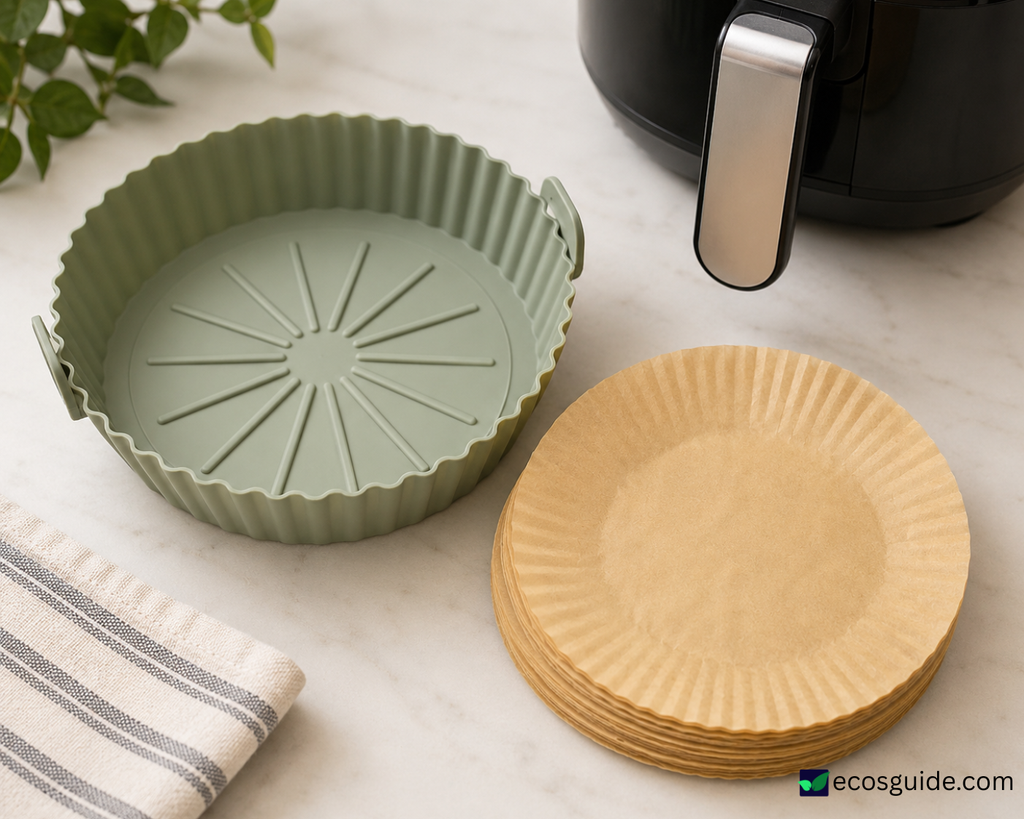
Here is what the math actually looks like:
| Material | Disposable parchment liners | Reusable silicone liner |
| Cost | ~$10 for 100 sheets = ~$0.10/use | ~$12 to $15 for a 2-pack |
| Waste per pack | 100 sheets to landfill | 1 liner, lasts years |
| Break-even | – | Roughly 15 uses |
| Fire risk | Yes if lifted | None |
| Dishwasher safe | No | Yes |
| PFAS concern | Depends on brand | None (silicone) |
The third option, which is honestly what I default to on most nights, is no liner at all. A well-designed air fryer basket cleans up in two minutes if you get to it before the residue bakes on.
For that two-minute clean, a plant-based dish soap that handles greasy air fryer parts and a sisal-bristle bamboo dish brush for the mesh do the whole job.
For heavier buildup, our full guide on how to clean an air fryer the eco way walks through the light, medium, and heavy tiers, including how to lift polymerised grease with the baking soda paste approach rather than harsh chemistry.
The EcosGuide Picks: Parchment I’d Actually Trust in My Own Air Fryer
If you want a shortcut through the buying-criteria checklist above, here are three picks that meet EcosGuide’s standards: unbleached, silicone-coated (not Quilon), PFAS non-detect where testing exists, and sized to fit standard basket-style air fryers.

If You Care Parchment Baking Paper is my strongest health-and-eco pick in the category. It’s unbleached, silicone-coated (not Quilon), FSC-certified, chlorine-free, and compostable.
Mamavation’s lab testing returned a non-detect result at 10 ppm for total fluorine on both the roll and the pre-cut sheet version.
If you want one box that does everything a home kitchen needs, this is the one.
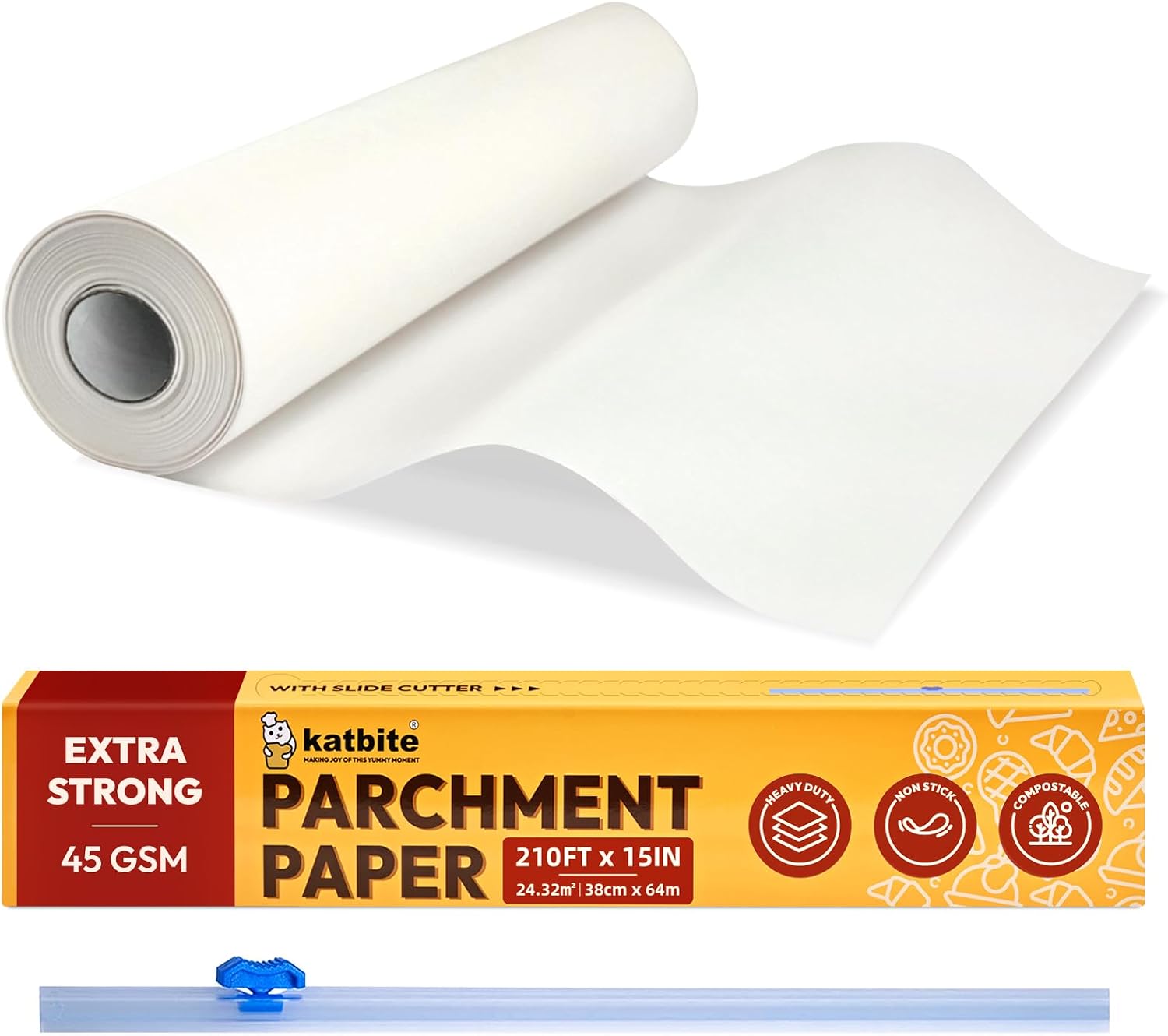
Katbite Heavy Duty Unbleached Parchment Paper is the more affordable Mamavation non-detect option.
Unbleached, silicone-coated on both sides, food-grade, and heat-safe from -68 to 425°F. The 15-inch roll cuts down easily to air-fryer-friendly squares, and the slide cutter on the box makes clean cuts easier than tearing.
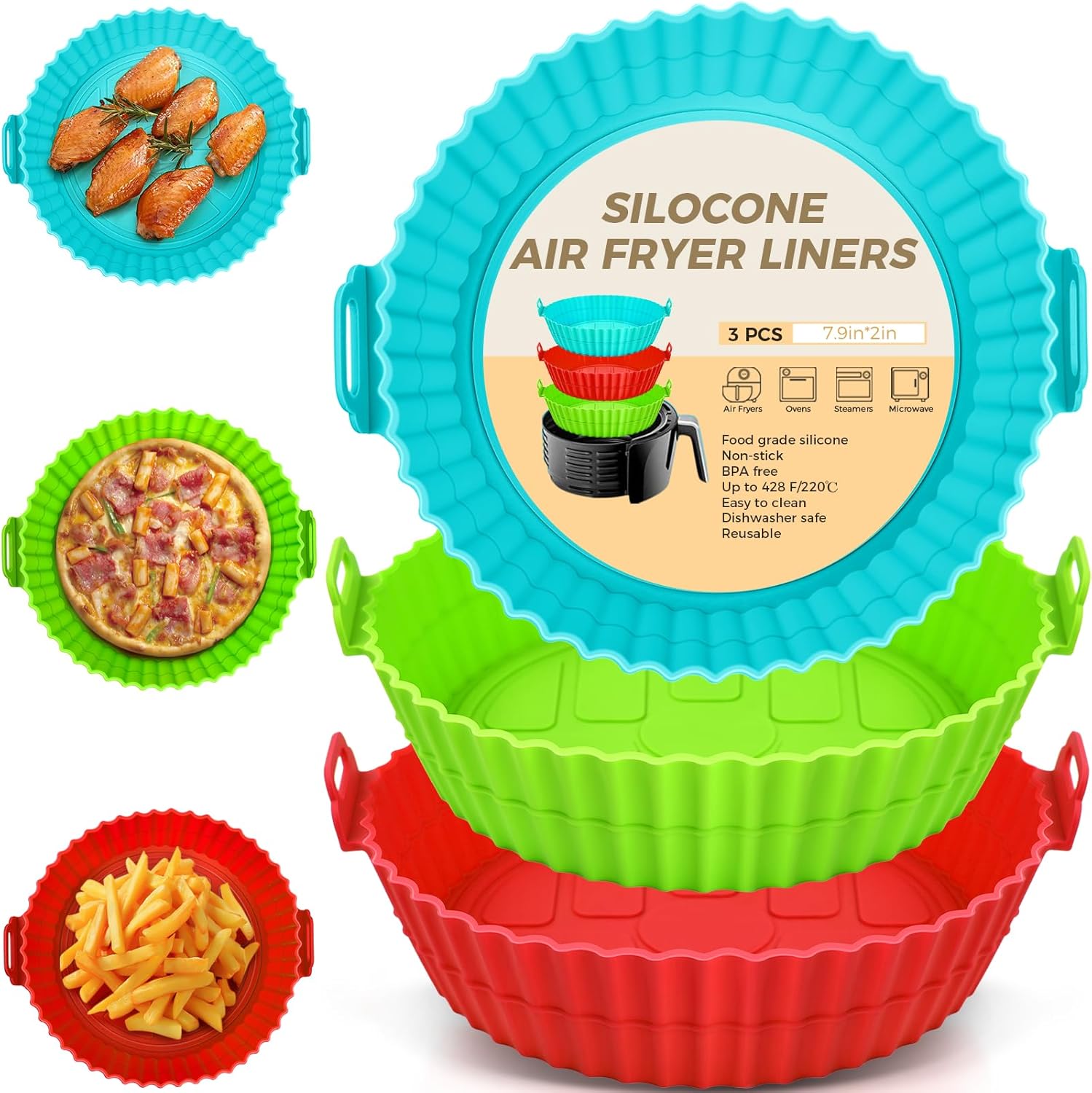
If you’re ready to skip disposables entirely, Buauty’s 3-pack of 8-inch food-grade silicone air fryer liners fits standard round basket air fryers, is dishwasher safe, heat-resistant, and replaces roughly 100 disposable sheets over its useful life.
Honest note: I haven’t tested this specific liner in my own kitchen, but based on the food-grade silicone material, the heat rating, and eco-minded buyer reviews, it checks the right boxes.
The Bottom Line
Parchment paper is safe in an air fryer when you use it the right way: added after preheating, weighed down, cut small, and rated for the heat.
What’s in the paper matters as much as how you use it, which is why I look for unbleached, silicone-coated, PFAS-tested brands.
And if you’re on the fence about single-use anything in your kitchen, a reusable silicone liner is the eco answer that pays for itself in about 15 uses.
Whichever way you go, the eco way to clean the basket afterward doesn’t need harsh chemistry either.
- The Short Answer: Is Parchment Paper Safe in an Air Fryer?
- What Actually Happens When Parchment Meets an Air Fryer
- The 5 Rules for Using Parchment Paper Safely in an Air Fryer
- The Warning Most Articles Miss: Toaster-Oven-Style Air Fryers
- What They Don’t Tell You: The Coating and PFAS Question
- When You Should NOT Use Parchment Paper in Your Air Fryer
- A Better Question: Do You Even Need Parchment Paper?
- The EcosGuide Picks: Parchment I’d Actually Trust in My Own Air Fryer
- The Bottom Line
- Frequently Asked Questions
Find More Tips At:


Frequently Asked Questions
Can you put parchment paper in an air fryer at 400°F?
Yes. Most plain parchment is rated to 420 to 450°F, and most air fryers max out at 400°F, so temperature is rarely the issue. The real risks are the sheet lifting into the heating element and blocking airflow, both solved by weighing it down with food and cutting it smaller than the basket.
What happens if parchment paper touches the heating element?
Parchment paper can ignite when it touches the heating element of an air fryer, because the element operates well above the paper’s flash point. The most common cause is a loose sheet lifted by the fan during preheating. If you see the paper lifting, turn the fryer off immediately.
Can you use parchment paper in a Ninja Foodi or Instant Vortex?
In basket-style models, standard parchment rules apply. In rectangular or toaster oven-style models (some Ninja Foodi variants, Instant Vortex Pro, Cuisinart TOA), Reynolds’ own liner guidance advises against parchment because the heating element sits closer to a lifted sheet. A reusable silicone liner is safer in those models.
What’s the difference between parchment paper and wax paper?
Parchment paper is coated with silicone, which is heat-resistant and rated for oven and air fryer use. Wax paper is coated with paraffin wax, which melts, smokes, and can ignite at air fryer temperatures. The two are not interchangeable, and wax paper should never be used in an air fryer.
Does parchment paper release chemicals in an air fryer?
It depends on the coating. Silicone-coated parchment (used by If You Care and Katbite) is considered food-safe at air fryer temperatures. Quilon-coated parchment, which uses a chromium compound, is a bigger question mark, and the coating type is almost never stated on the box. Unbleached, silicone-coated, PFAS-tested paper avoids most of the concern.
Is parchment paper better than aluminum foil in an air fryer?
Both work. Parchment is better with acidic foods (tomatoes, lemon, vinegar marinades) because aluminum foil reacts with acids. Foil is better when you need to shape a barrier or partially cover a food. Neither should be used during preheating or allowed to block the basket airflow holes.
What can I use instead of parchment paper in an air fryer?
A reusable silicone air fryer liner is the most eco-friendly alternative, and it replaces roughly 100 disposable sheets over its useful life. Aluminum foil also works for non-acidic foods, and no liner at all is the option most air fryer manufacturers actually recommend for airflow and crispiness.
