
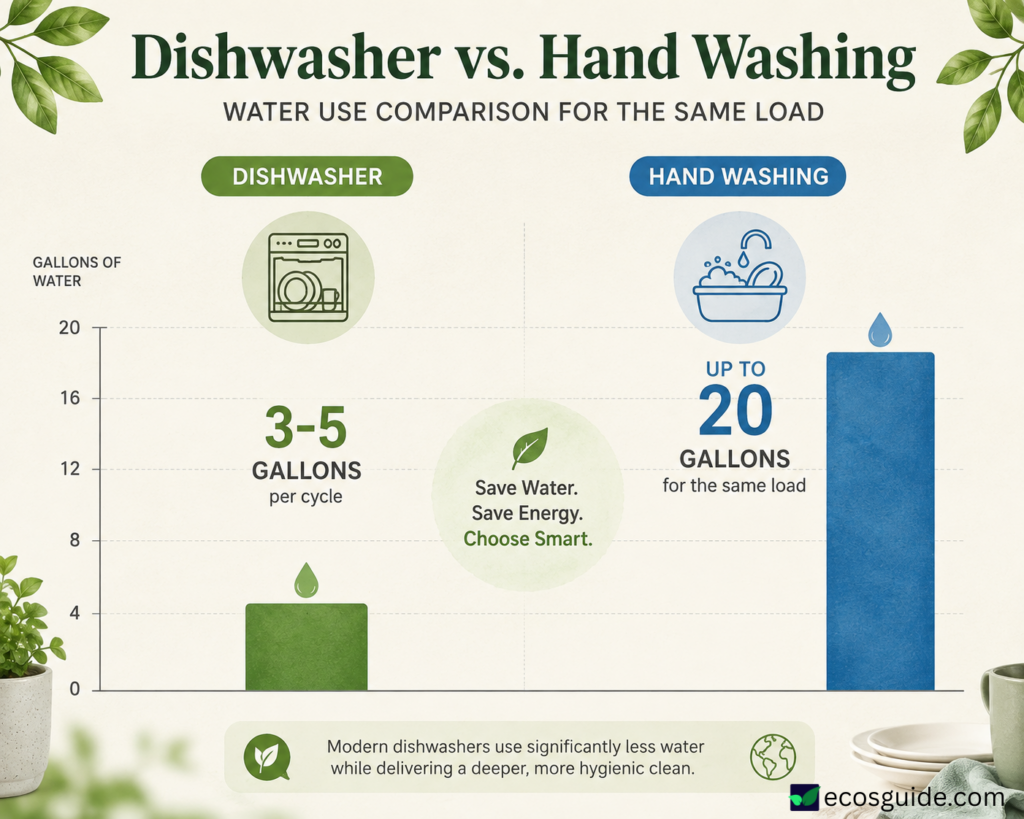
In the dishwasher vs hand washing debate, a modern Energy Star dishwasher uses less water than hand washing in almost every real-world scenario, typically 3 to 5 gallons per cycle versus up to 20 gallons for hand washing the same load.
But which method is actually better for the environment depends on three things the internet keeps skipping: how you use the machine, what soap you use, and what goes down your drain.
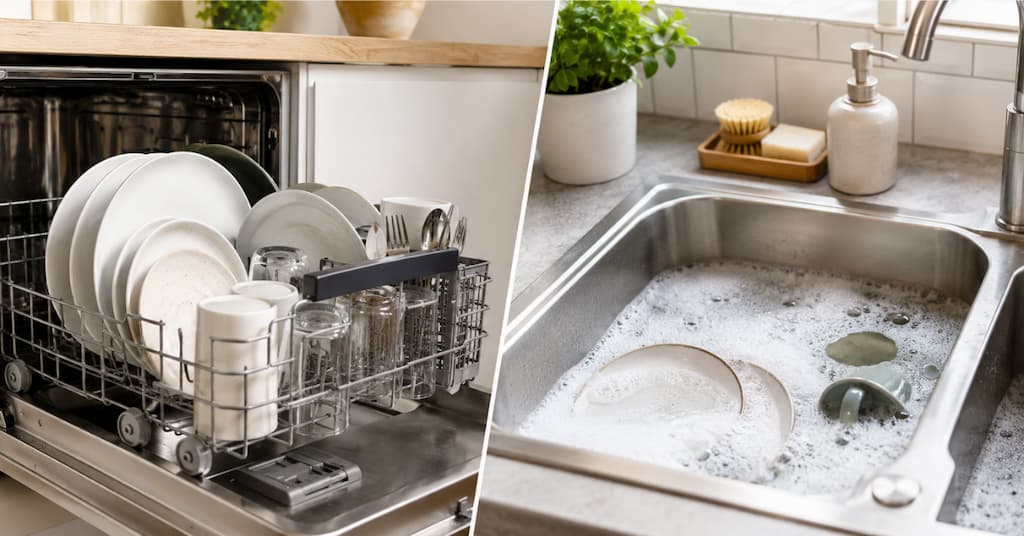
Illustration generated with AI for reference.
It’s easy to forget that whatever leaves our kitchen sink has to go somewhere.
When I started looking into what’s actually in the water going down our drains every day, from both dishwashers and sinks, I couldn’t look away.
So I did the research. Not on which method wins on water alone, but on what the whole choice really costs. Here’s what I found.
Key Takeaways
- A modern Energy Star dishwasher uses 3 to 5 gallons of water per cycle versus up to 20 gallons for hand washing the same load, and produces less than half the greenhouse gas emissions over a 10-year lifecycle.
- Dishwasher water reaches sanitizing temperatures of 140°F to 155°F that a kitchen sink cannot; hand-washing cleans dishes but rarely sanitizes them.
- The biggest eco decision is not machine versus sink but what goes down the drain: conventional detergents and synthetic sponges send surfactants, dyes, fragrances, and microplastic fibres into waterways.
- For most households, run a full dishwasher with an eco detergent and skip the heated-dry cycle
- For sink-only households, use the two-basin or soap-first method with a plant-based soap and plant-fibre scrubber
How Much Water Does Dishwasher vs Hand Washing Really Use?
The water numbers are what most articles lead with, and for good reason. They are the clearest part of the whole comparison.
A full-load Energy Star dishwasher uses 3 to 5 gallons of water per cycle, compared with up to 20 gallons for hand washing the same load.
Energy Star certifies standard-size dishwashers at no more than 3.5 gallons per cycle.
A widely cited study came from the University of Bonn, as reported by consumer group Choice. Researchers ran the same 144-item load through both methods. The dishwasher used about 13 litres (roughly 3.4 gallons). Hand-washers used about 100 litres (around 26 gallons) on average for the same load.
Here is the caveat almost no one mentions. Bonn’s hand-wash results ranged from 33 to 440 litres. Habits matter enormously. A careful two-basin method with the tap off uses a fraction of what a running tap does.
A University of Michigan lifecycle study as reported by AOL reached similar territory. Over 10 years, dishwashers used 16,300 gallons versus 34,200 for hand washing. That is more than twice the water for the same result.
What About Energy? The Hidden Hot-Water Cost of Hand Washing
Water is only one input. The other one, and the one that quietly makes hand washing more energy-intensive than most people realize, is hot water.
Your water heater is typically the second-biggest energy user in a US home after heating and cooling.
Every gallon of hot water has to be heated somewhere, usually by natural gas or electricity. That heating carries a real greenhouse gas footprint.
The same University of Michigan lifecycle study as reported by AOL found dishwashers produced 2,090 kg of greenhouse gases over 10 years, compared with 5,620 kg for hand washing the same volume of dishes. That is a nearly threefold gap.
The reason is simple. A modern dishwasher heats water internally, on demand, only what it needs.
A kitchen sink pulls hot water from a tank that has been sitting all day, losing heat and reheating over and over.
Leave the tap running while you scrub, and most of that hot water goes straight down the drain without touching a dish.
The easiest energy win on the dishwasher side is skipping the heated dry cycle. Open the door at the end and let dishes air-dry. That cuts roughly 15 percent of the cycle’s energy use.
Here’s the same picture in one place:
| Metric | Dishwasher (Energy Star, full load) | Hand washing (typical) |
| Water per load | 3 to 5 gallons | 10 to 20 gallons |
| Water over 10 years | 16,300 gallons | 34,200 gallons |
| Greenhouse gas emissions (10 years) | 2,090 kg CO2e | 5,620 kg CO2e |
| Wash water temperature | 140°F to 155°F | Up to 120°F (hand-safe) |
| Sanitizes dishes | Yes | No, only cleans |
Sources: Energy Star (water per load), University of Michigan Center for Sustainable Systems (10-year water and emissions), USDA (sanitizing temperature threshold).
Which Method Actually Cleans Dishes Better?
Before we get into the eco verdict, one physical fact is worth naming, because it changes how you think about “clean.”
Dishwasher water reaches 140°F to 155°F, hot enough to sanitize dishes; sink water is safe for hands only up to around 120°F, which is why hand-washed dishes are cleaned but rarely sanitized.
USDA guidance sets 140°F as the sanitizing threshold for dishware, which is well above what any human can tolerate at the sink.
This isn’t a moral point. Hand washing gets dishes visibly clean, and for most everyday meals that is what actually matters.
Bacterial risk from a family kitchen is low, especially if hands are washed and dish cloths are changed regularly.
But it does explain why dishwashers are the standard in commercial kitchens and healthcare settings, and why some households (small children, immunocompromised family members, regular raw poultry prep) choose them for that reason alone.
Neither method is wrong here. They just do slightly different jobs.
What Goes Down Your Drain? The Eco Question Nobody’s Asking
Here is where almost every dishwasher-vs-hand-washing article stops short, and where the real environmental decision actually lives.
Both methods send water into the same wastewater stream. That water carries whatever soap or detergent you used, plus whatever else came off your dishes or your sponge.
The environmental cost of doing dishes is not only about water volume, it is also about what enters the wastewater stream: surfactants, chelators, fragrances, dyes, and microplastic fibres from synthetic sponges.
Take conventional dishwasher detergent. Most mainstream formulations contain synthetic surfactants (to cut grease), chelators (to soften water), fragrances, dyes, and optical brighteners, which do nothing for cleaning but make dishes look whiter under light.
Conventional dish soap has a similar profile. Synthetic surfactants like sodium laureth sulfate (SLES) and sodium lauryl sulfate (SLS) do the actual cleaning work, but they are often paired with synthetic fragrance blends and dyes that add nothing functional and do not fully break down in treatment.
All of it goes somewhere. Down your drain, through municipal treatment, and from there into local rivers, lakes, and eventually the ocean.
Treatment plants remove a lot, but not everything.
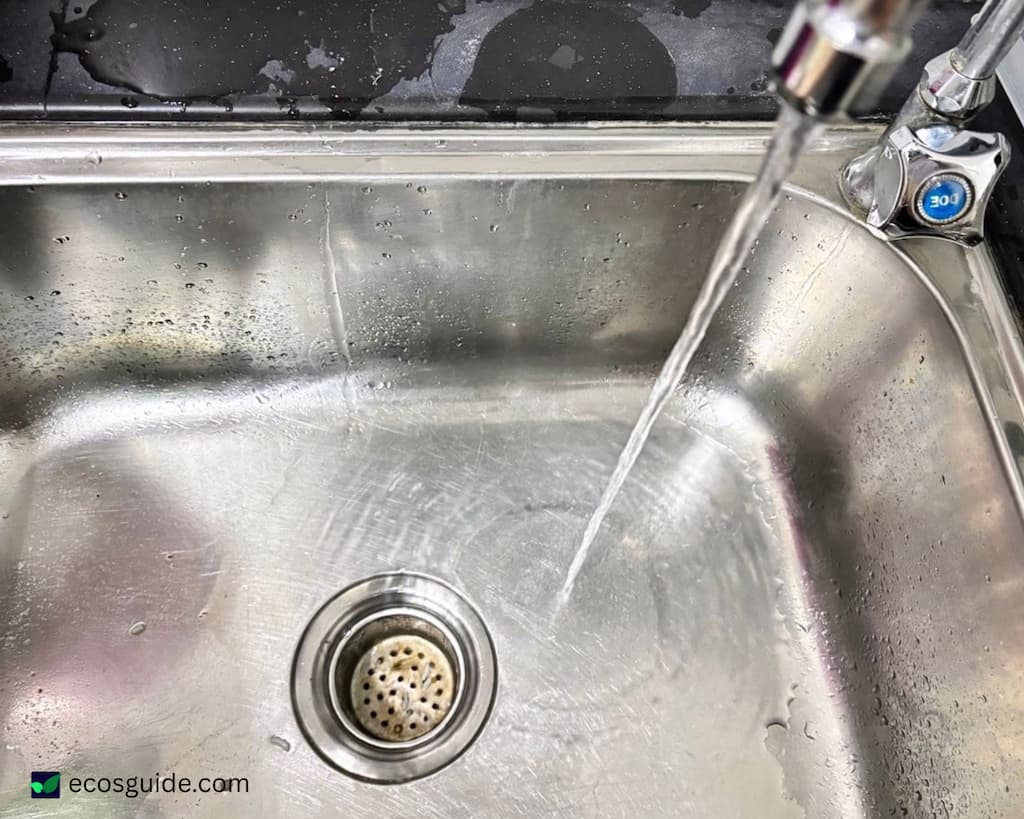
Those fibres are small enough to pass through most treatment systems and end up in waterways, where they have been documented in fish, shellfish, and drinking water samples.
Choosing plastic-free dish scrubbers made from coconut coir, loofah, or plant-fibre bristles is one of the simplest ways to close that gap.
This is where the eco decision actually happens: not machine vs sink, but what you put in the water. Switching to eco-friendly dishwasher detergents or a plant-based dish soap changes the entire calculation, regardless of which method you use.
What About the Dishes You Should Always Hand-Wash Anyway?
Even if you are firmly team-dishwasher, some kitchen items really should not go in it. The heat, the detergent chemistry, and the water pressure damage things a dishwasher was never designed to handle.
Cast iron, chef’s knives, wooden cutting boards, hand-painted china, and non-stick copper cookware should always be hand-washed regardless of which method you prefer for everything else.
| Item | Why not dishwasher-safe |
| Cast iron | Loses its seasoning and can rust within a single cycle |
| Chef’s knives | Blade dulls from rack contact; hot detergent water pits the steel over time |
| Wooden cutting boards and utensils | Warp, crack, and dry out from repeated heat and moisture cycles |
| Hand-painted china and delicate glassware | Chip against racks; painted finishes fade under hot detergent water |
| Non-stick and enameled copper cookware | Coatings degrade from harsh detergents faster than from any cooking use |
| Small appliance parts (air fryer baskets, blender jars, kettle interiors) | Non-stick coatings wear, glass clouds, and rubber seals loosen with repeated cycles |
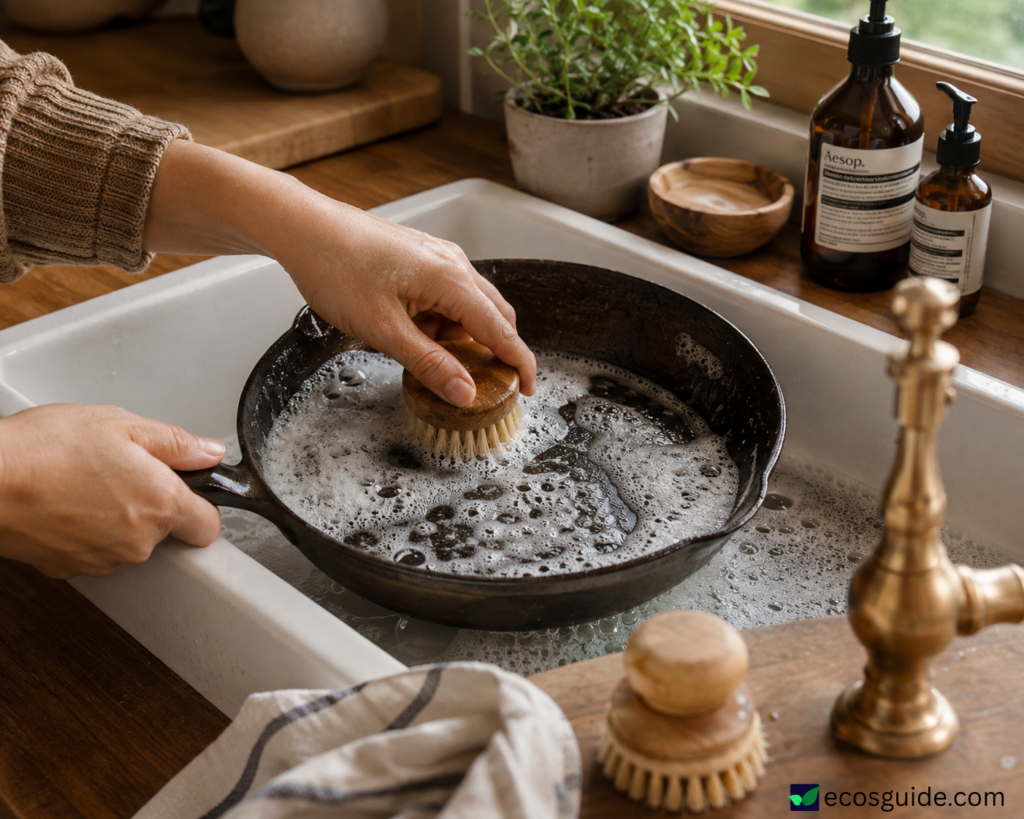
Illustration generated with AI for reference.
What About Small Kitchen Appliances?
Small kitchen appliance parts are their own category.
Air fryer baskets, blender jars, coffee-maker carafes, kettle interiors, and toaster crumb trays are usually best hand-washed even when the manufacturer says the dishwasher is fine.
The reason is that repeated dishwasher cycles wear down non-stick coatings on air fryer baskets, cloud glass blender jars and carafes, dull stainless steel finishes, and can loosen the rubber seals and gaskets that keep small appliances safe to use.
A quick hand wash with warm water and a plant-based dish soap protects the appliance and extends its life, which is quietly one of the most underrated eco moves in any kitchen.
How to Hand-Wash Dishes to Actually Save Water
If you are a sink-only household, or you hand-wash some dishes even with a dishwasher available, the way you do it matters far more than the fact that you are doing it.
Hand washing dishes uses far less water when you keep the tap off between scrubbing steps: soap up the entire stack first, then rinse in one pass at the end, and air-dry rather than towel-dry.
Three techniques get you most of the way there.
The two-basin method:
- Fill one basin (or bowl, or one side of a double sink) with hot soapy water.
- Fill a second one with warm rinse water.
- Wash in the first, rinse in the second, air-dry on a rack.
Water use drops sharply because you are never running the tap continuously.
Scrape, don’t rinse. Food scraps into the compost or the trash before dishes hit the sink. Rinsing plates under a running tap wastes gallons of water and doesn’t help you clean them.
The soap-first layer method. This one is simple and works well if you don’t want to deal with two basins. With the tap off, soap up every dish in the stack first, working through pots, plates, cutlery, glasses.
Only then, turn the tap on and rinse everything in one continuous pass. Air-dry on the rack.

The tools matter too. Choose eco-friendly dish soaps that use plant-based surfactants and skip synthetic fragrance, since anything that goes on your hands and dishes also ends up in the water stream.
And pair them with plant-fibre or compostable scrubbers instead of standard polyester or melamine sponges, so you are not shedding microplastics with every wash.
How to Use Your Dishwasher More Efficiently
If you have a dishwasher, running it well is a genuinely low-impact way to clean dishes. Running it poorly cancels out the entire water advantage.
Run full loads only. A half-full dishwasher uses almost the same water and energy as a full one, so waiting until it is properly loaded is the single biggest lever you have.
Skip the pre-rinse. This is the myth that costs the most water. Consumer Reports, Cascade, Bosch, and every major dishwasher manufacturer have confirmed for years that modern dishwashers work better without pre-rinsing.
The detergent enzymes actually need food particles to activate against; a fully rinsed dish gives them nothing to grip.
Finish estimates that skipping the pre-rinse saves around 1,000 litres (over 260 gallons) of water per household per year.
Modern dishwashers work more effectively without pre-rinsing dishes, so scraping food scraps into the compost or trash and loading dishes directly can save around 1,000 litres (over 260 gallons) of water per household per year.
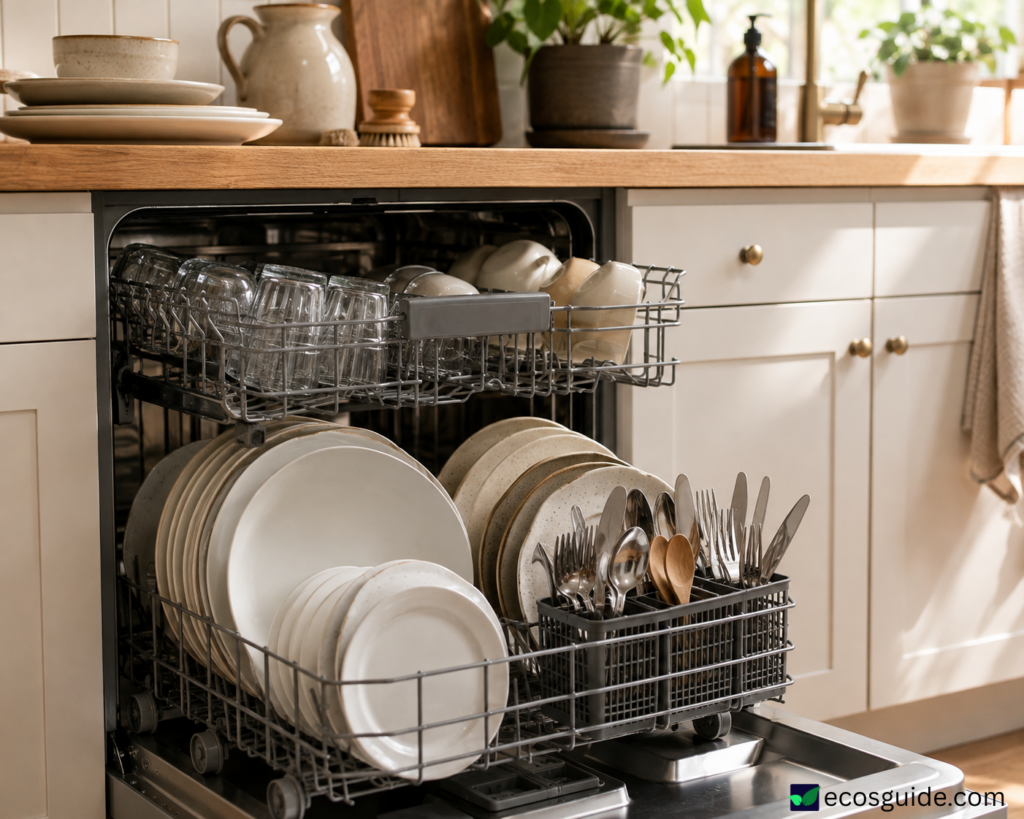
Illustration generated with AI for reference.
Use the eco cycle. It runs longer at a lower temperature and uses less water and energy overall. It is genuinely designed for everyday loads and is not a marketing gimmick.
Air-dry instead of heated-dry. Open the door at the end of the cycle and let the residual heat do the work. That single habit saves roughly 15 percent of the cycle’s energy.
Choose a plant-based, fragrance-free detergent. This is the biggest chemistry lever you have. Switching to eco-friendly dishwasher detergents changes what goes down your drain more than any technique will.
Clean the dishwasher itself. A greasy filter or a scaled-up spray arm forces the machine to work harder for worse results.
A monthly rinse cycle with vinegar and baking soda keeps it running efficiently. If you want the full walk-through, our guide on how to clean your dishwasher naturally with vinegar and baking soda covers it step by step.
What About Dishwasher Pods and PVA?
Dishwasher pods are convenient, but they come wrapped in polyvinyl alcohol (PVA or PVOH), the polymer film that dissolves in water.
The environmental question about that film is genuinely contested.
A 2021 Arizona State University study suggested a significant portion of PVA may not fully biodegrade during standard wastewater treatment; industry groups counter that treatment plants break it down completely under real-world conditions, as reported by Chemical & Engineering News.
Both sides have peer-reviewed research on the table, and this article is not the place to settle it.
The cautious path, if you would rather not bet on the outcome, is to choose a powder, gel, or tablet formula in recyclable or refillable packaging until the science lands somewhere firm.
My Honest Take
In my own kitchen, I hand-wash. Not because I think it is the objectively greener choice (the research above actually leans the other way for most households), but because it works for how I cook and how many dishes I generate on any given day.
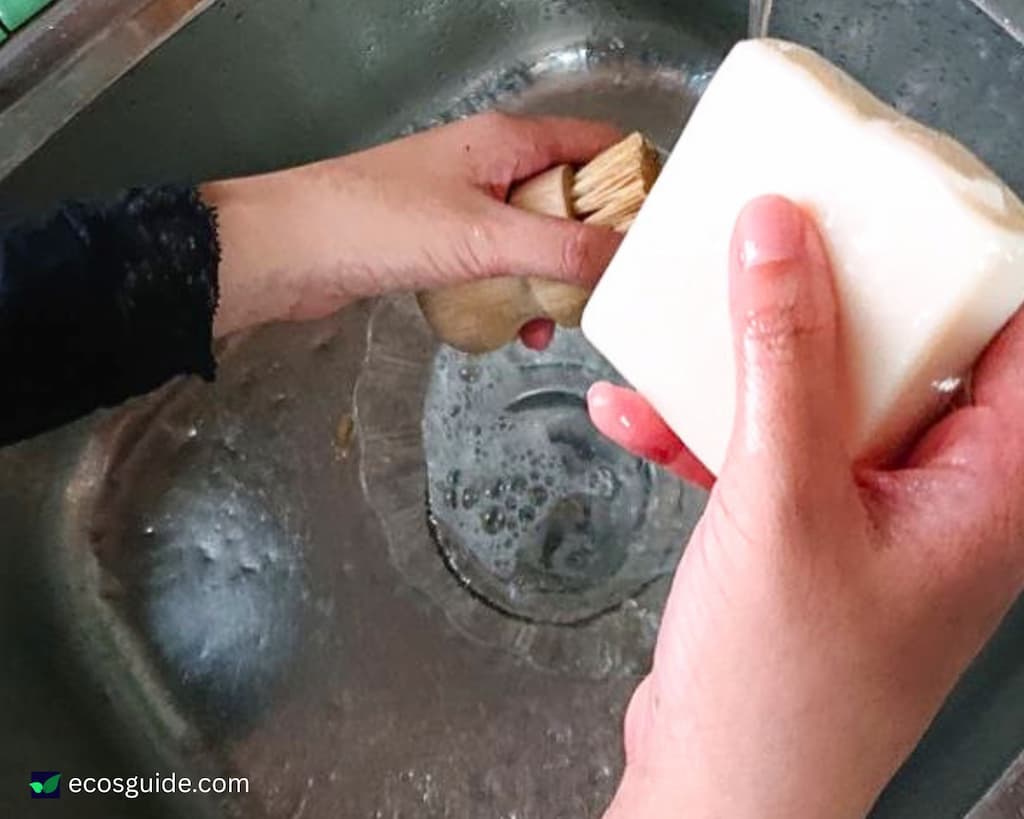
I don’t want to run a machine to clean four bowls and a spatula.
My method is simple. I soap up every dish first with the tap off, work through the whole stack in one layer, and only turn the water on at the end for a single rinse pass.
Then I air-dry everything on the rack. No continuously running tap, no hot water sitting in the sink.
I don’t think there’s a single right answer for everyone. If you have a dishwasher, running it full with an eco detergent and skipping the heated dry is a genuinely strong environmental choice.
If you don’t, or you just prefer the sink, the method I use is what I would suggest. The wrong choice isn’t dishwasher or sink. The wrong choice is whichever one you’ll do wastefully.
The Verdict: Dishwasher vs Hand Washing, Bottom Line
For most US households, a modern Energy Star dishwasher used with full loads and an eco-friendly detergent is the more water- and energy-efficient choice; for sink-only households, hand washing with the two-basin method and a plant-based soap is genuinely low-impact.
The gap between the two methods narrows a lot when you are a careful hand-washer, and it disappears entirely if you are a careless one.
What matters more than either choice is the ingredients in your soap, the material in your scrubber, and the discipline of not running water you don’t need.
Small Kitchen Choices, Real Change
So, dishwasher vs hand washing. For most households with a machine, running it full and using an eco detergent is the greener choice.
For everyone else, hand-washing done well is genuinely low-impact. But the biggest eco decision on this whole page is not machine vs sink, it is what you send down the drain with either method.
If you know which side you are on, the next step is choosing what you clean with. Start with our roundup of eco-friendly dishwasher detergents or eco-friendly dish soaps.
- How Much Water Does Dishwasher vs Hand Washing Really Use?
- What About Energy? The Hidden Hot-Water Cost of Hand Washing
- Which Method Actually Cleans Dishes Better?
- What Goes Down Your Drain? The Eco Question Nobody’s Asking
- What About the Dishes You Should Always Hand-Wash Anyway?
- How to Hand-Wash Dishes to Actually Save Water
- How to Use Your Dishwasher More Efficiently
- My Honest Take
- The Verdict: Dishwasher vs Hand Washing, Bottom Line
- Small Kitchen Choices, Real Change
- Frequently Asked Questions
Find More Tips At:


Frequently Asked Questions
Does hand washing dishes use more water than a dishwasher?
Yes, in almost every real-world scenario. Modern Energy Star dishwashers use 3 to 5 gallons per cycle; hand washing the same load typically uses 10 to 20 gallons. The exception is very small loads (under about 4 items) washed with a two-basin, tap-off method.
Is a dishwasher more environmentally friendly than hand washing?
For most households, yes. A modern Energy Star dishwasher run with full loads, an eco detergent, and no heated dry cycle produces significantly less water use and lower greenhouse gas emissions than hand washing the same volume of dishes. For very efficient hand-washers using a two-basin, tap-off method, the gap narrows considerably.
Do you have to rinse dishes before putting them in the dishwasher?
No. Modern dishwashers, including nearly every model made in the last decade, are designed to work without pre-rinsing. Scraping food scraps into the compost or trash is enough. Consumer Reports, Bosch, and major detergent manufacturers all confirm pre-rinsing wastes water and can actually make dishwashers less effective.
What’s the most eco-friendly way to hand wash dishes?
Use a two-basin method (or a soap-first layer method with the tap off), scrape food scraps rather than rinsing them, choose a plant-based fragrance-free dish soap, use a plant-fibre or compostable scrubber, and air-dry rather than towel-dry. This can bring hand-washing water use down to around 33 litres for a full load, which is the low end of the University of Bonn dishwashing study range.
How much water does a dishwasher use per load?
A full-load Energy Star dishwasher uses 3 to 5 gallons (about 11 to 19 litres) of water per cycle. Standard-size Energy Star models are certified at no more than 3.5 gallons per cycle. Older non-Energy-Star models can use 6 gallons or more.
Are dishwasher pods bad for the environment?
The science is genuinely contested. Dishwasher pods use a polyvinyl alcohol (PVA/PVOH) film that dissolves in water; some independent research suggests this film may not fully biodegrade during wastewater treatment, while industry bodies argue it does. If you prefer the cautious path, choose a powder, gel, or tablet formula in recyclable or refillable packaging.
What dishes should I never put in the dishwasher?
Cast iron, chef’s knives, wooden cutting boards, wooden utensils, hand-painted china, delicate glassware, and non-stick copper cookware should always be hand-washed. Small kitchen appliance parts (air fryer baskets, blender jars, coffee-maker carafes, kettle interiors, toaster crumb trays) are also generally safer to hand-wash even when the manufacturer allows dishwasher use.
Do sponges shed microplastics when you wash dishes?
Yes. Standard dish sponges, polyester scrubbers, and melamine sponges shed microplastic fibres into wastewater with every use. Plant-fibre scrubbers (coconut coir, loofah, wooden brushes with plant-fibre bristles), silicone scrubbers, and compostable options avoid this hidden environmental cost.
