
To descale an electric kettle, fill it halfway with equal parts water and white vinegar (or stir 1 to 2 tablespoons of food-grade citric acid into a full kettle), boil, let it sit for 20 minutes, then rinse and boil fresh water twice.
Doing this every 1 to 3 months keeps your kettle boiling faster, your water tasting cleaner, and the appliance itself lasting years longer.
The method you pick matters as much as the result, especially for what it means for your drains.
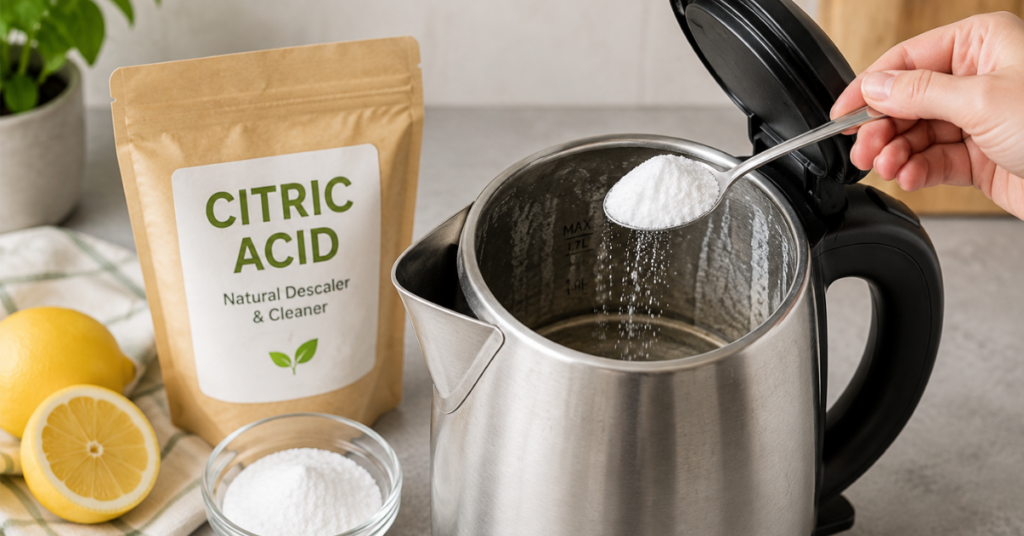
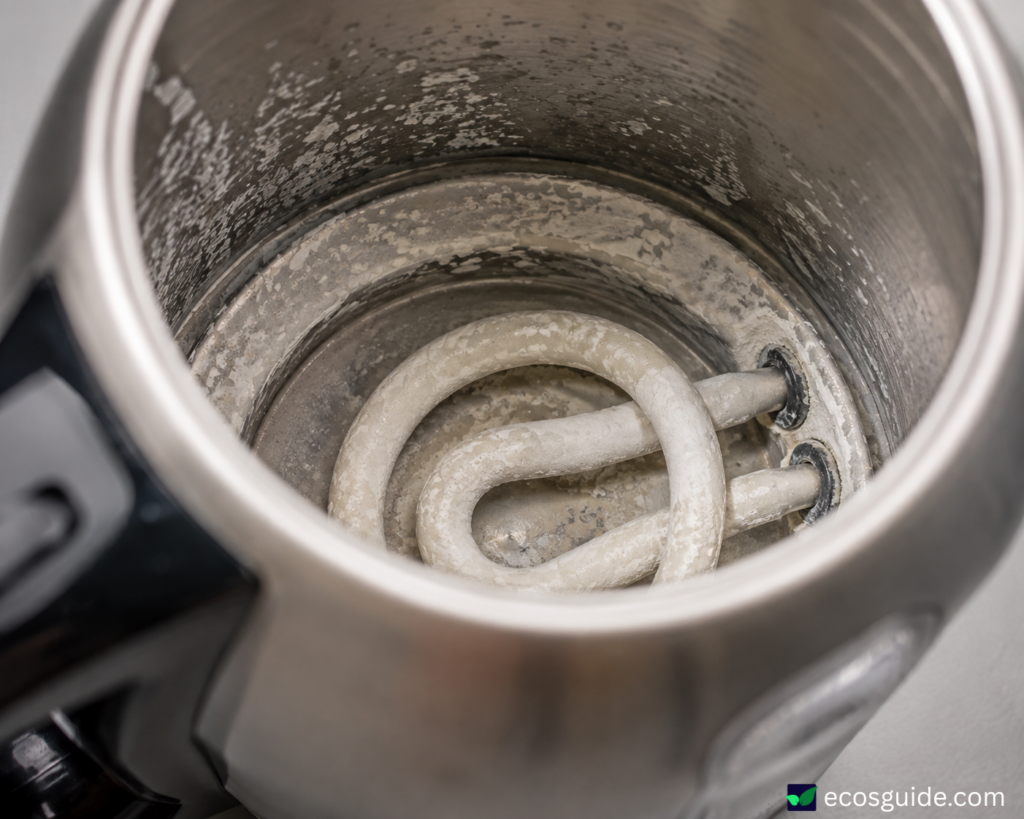
When I inherited my mom’s electric kettle, I noticed the chalky white layer inside before I even filled it for the first time.
I stood there for a moment, kettle in hand, not sure how I was supposed to shift that without wrecking the thing. It’s easy to forget that whatever we rinse out of a kettle has to go somewhere.
Down the drain, then into the water system. That’s why the method matters as much as the result.
Key Takeaways
- Citric acid is the eco pick. Food-safe, odorless, and gentler on plastic-bodied kettles and rubber gaskets than vinegar.
- Vinegar works too. Dilute 1:1 with water, soak for 20 minutes, and rinse-boil twice to clear the smell.
- Skip baking soda for descaling. It is alkaline, and so is limescale. Chemically, it cannot dissolve it.
- Skip commercial descaler tablets that are just dyed-and-fragranced citric acid at 5 to 10 times the price of the plain powder.
- Descale every 1 to 3 months in typical water, every 2 to 6 weeks in hard-water areas, and every 6 to 12 months in soft-water areas. Or whenever you can see the buildup.
Why Your Electric Kettle Needs Descaling
Limescale is a chalky deposit of calcium carbonate that forms when hard water is heated in a kettle.
It’s completely natural, and it isn’t dangerous to drink.
The World Health Organization does not classify hard-water minerals as a health risk, so if you’ve been quietly worrying about the flakes at the bottom of your cup, you can stop.
The real reasons to descale are practical, not medical.
Is Limescale in a Kettle Safe to Drink?
Yes. Limescale is calcium carbonate, the same compound as chalk and eggshells. Swallowing trace amounts is harmless.
It’s mechanically inefficient and unpleasant to look at, but it isn’t a health issue.
What Limescale Actually Costs You
Three things: energy, taste, and lifespan.
Scale forms an insulating layer on the heating element, forcing it to work harder to reach boiling point.
Industry research on kettle efficiency suggests a scaled kettle uses roughly 10 to 15 percent more electricity per boil.
Your tea and coffee pick up a chalky, metallic edge, and over time the buildup burns out the element earlier than it needs to go.
How Often Should You Descale an Electric Kettle?
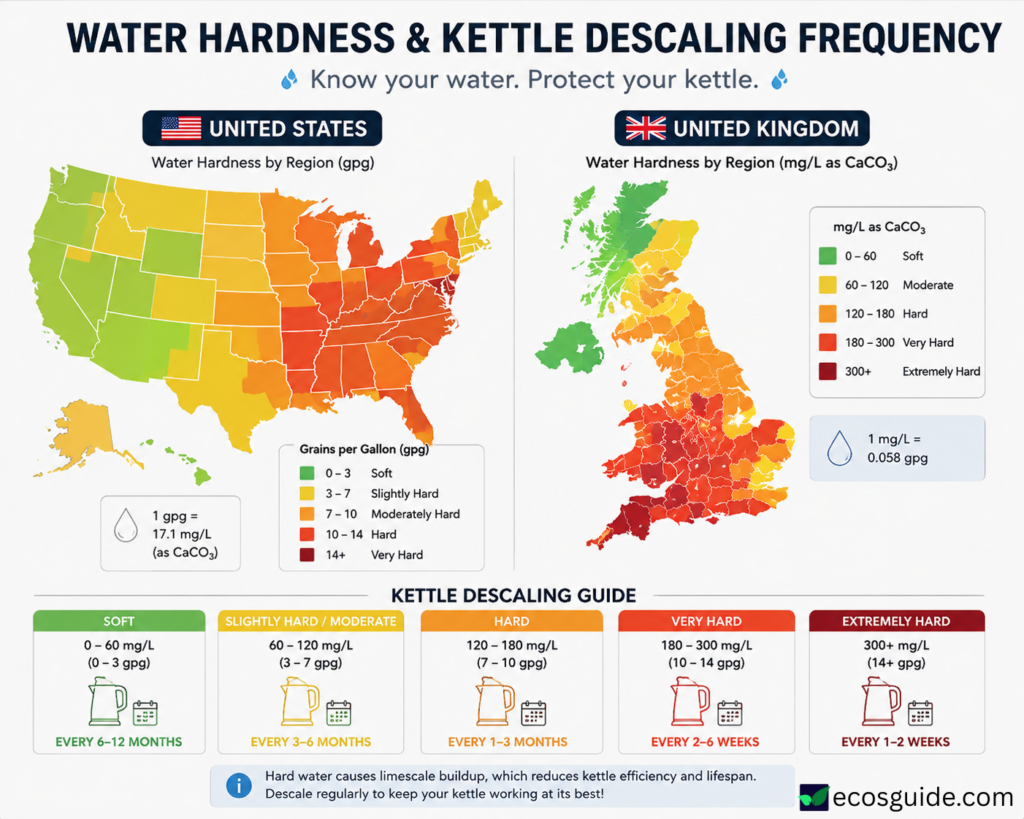
Descale every 1 to 3 months for typical use, every 2 to 6 weeks in hard-water areas, and every 6 to 12 months in soft-water areas.
Let visible buildup guide you.
Water hardness varies wildly by region, so use the table below to work out roughly where you sit.
| Water hardness (mg/L CaCO3) | Category | Descale roughly |
| 0 to 60 | Soft | Every 6 to 12 months |
| 60 to 120 | Slightly hard / Moderate | Every 3 to 6 months |
| 120 to 180 | Hard | Every 1 to 3 months |
| 180 to 300 | Very hard | Every 2 to 6 weeks |
| 300+ | Extremely hard | Every 1 to 2 weeks |
In the US, parts of Arizona, Florida, Texas, and much of the Midwest run hard to very hard, while the Pacific Northwest and New England tend to be softer.
The USGS water hardness data gives you a regional starting point, and your local water utility’s annual quality report has the exact number.
In the UK, London, Essex, Surrey, and East Anglia are the hardest zones. The Drinking Water Inspectorate’s hardness classification is a good place to check where you sit, alongside your water company’s own reporting.
The buildup you actually see is a better guide than the calendar. Flakes at the bottom or a chalky film on the walls means it’s time.
What You’ll Need
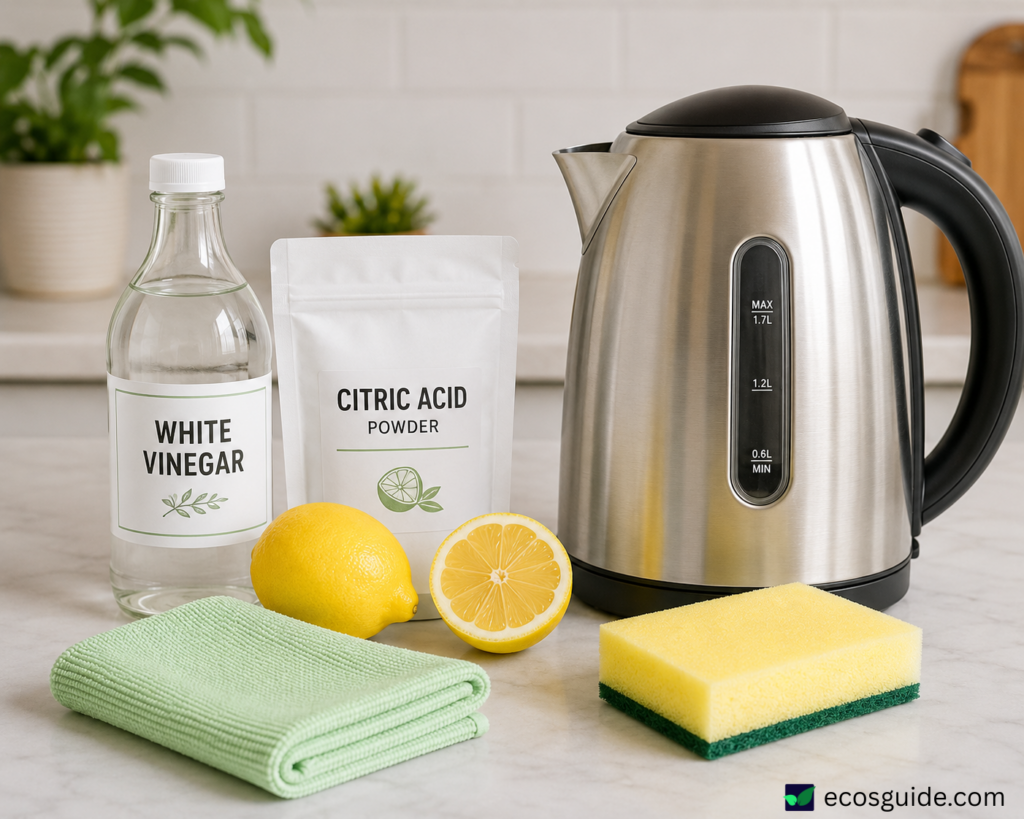
- White distilled vinegar (not malt, apple cider, or balsamic)
- Food-grade citric acid powder (single ingredient, no dyes or fragrance)
- A fresh lemon (optional, if you’d rather not stock the other two)
- A small soft sponge
- A clean microfiber cloth
- A small bowl for soaking the mesh filter
Food-grade citric acid is the version to buy. It’s the same molecule found in citrus fruits, purified for kitchen use.
Industrial-grade can carry contaminants you don’t want near drinking water, and it costs about the same, so there’s no reason to save the pennies.
A microfiber cloth is better than paper towels for the exterior wipe, and keeping your microfiber cloth lint-free is its own small habit.
Method 1: Citric Acid (The Eco Pick)
Add 1 to 2 tablespoons of food-grade citric acid to a full kettle of water, bring to a boil, let it sit for 20 to 30 minutes, then rinse.
If someone asked me what to buy specifically for descaling with the least fuss, I’d point them to a bag of food-grade citric acid.
It’s odorless, food-safe, and gentler on plastic bodies and rubber gaskets than vinegar. That matters more than most articles let on, because most modern electric kettles have plastic somewhere in their construction.
How to Descale a Kettle with Citric Acid (Step-by-Step)
- Fill the kettle to its maximum line with fresh cold water.
- Stir in 1 to 2 tablespoons of food-grade citric acid powder until it dissolves.
- Boil the kettle. Once it clicks off, leave the solution to sit for 20 to 30 minutes.
- Pour out the solution. You may see loose flakes come with it. That’s the point.
- Rinse the kettle two or three times with fresh water.
- Boil one full kettle of clean water and pour it away before using again.
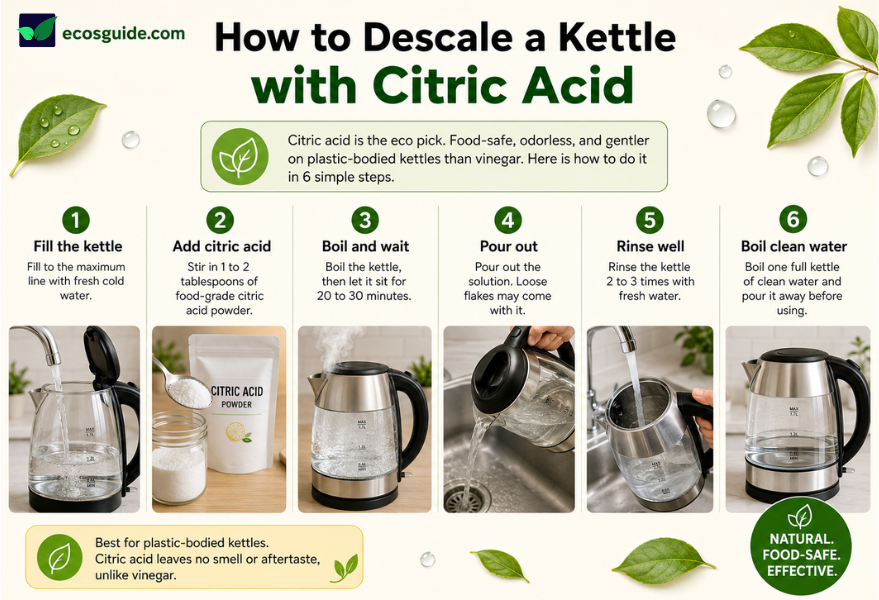
Why Citric Acid Is Best for Plastic-Bodied Kettles
Citric acid dissolves calcium carbonate without leaving any scent behind, and it doesn’t settle into the pores of plastic the way vinegar does.
If you’ve ever noticed a lingering vinegar taste in your tea for days after descaling, this is why.
It’s the method I’d recommend to most readers, and especially anyone doing a clean kettle with citric acid for the first time.
Method 2: White Vinegar (Cheapest, Works, But Smells)
To descale a kettle with vinegar, fill it halfway with equal parts water and white vinegar, boil, let it sit for 20 minutes, then rinse and boil fresh water twice.
I’ll be honest, vinegar is the one I actually reach for in my own kitchen most of the time, because a bottle already lives under my sink. It works.
The trade-off is the smell, and the fact that most people skip the two-boil rinse and end up with faintly vinegar-flavored tea for a week.
How to Descale a Kettle with Vinegar (Step-by-Step)
- Fill the kettle halfway with equal parts white distilled vinegar and water.
- Boil the kettle. Once it clicks off, let it sit for 20 minutes.
- Pour out the solution.
- Rinse the kettle two or three times with fresh water.
- Fill with clean water and boil it fully, then pour away. Repeat this rinse-boil once more.
Use distilled white vinegar only. Malt and apple cider are lower in acetic acid and can leave color behind. Balsamic has added sugars that will bake onto the element.
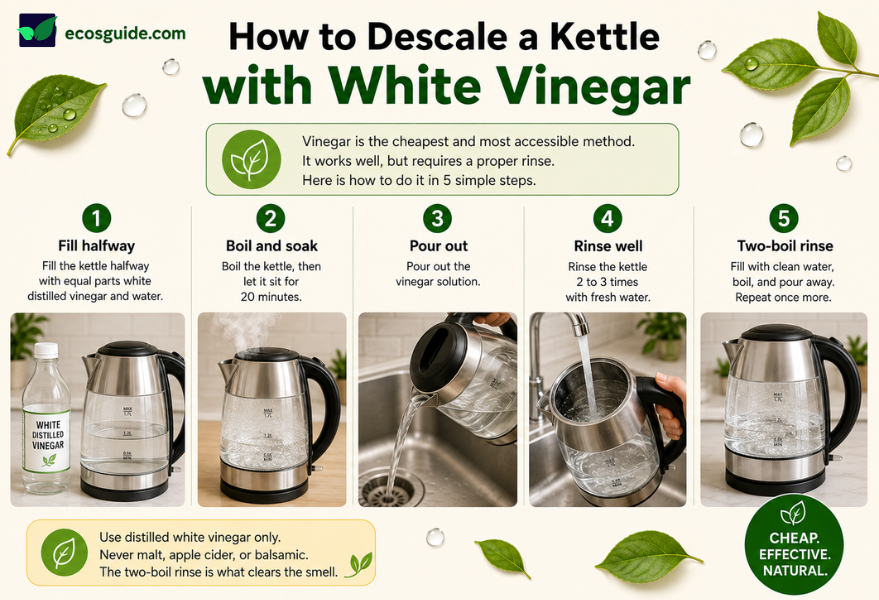
Why the Two-Boil Rinse Matters
Vinegar residue clings to the interior even after a cold rinse. Boiling clean water twice is what actually clears it.
Skip that step and your next few brews taste like it, and that’s the single most common complaint about how to clean a kettle with vinegar.
Plastic-bodied kettles absorb the smell more than stainless, which is one more reason to consider Method 1 if yours isn’t full stainless.
Method 3: Fresh Lemon
If you’d rather not stock vinegar or citric acid, a fresh lemon does the same job on a smaller scale.
Slice a lemon, drop the slices into a full kettle of water, bring it to a boil, and let it sit for 20 minutes before rinsing.
It leaves a pleasant scent behind and it’s food-safe. The active ingredient in a lemon is citric acid, so this is chemically the same job as Method 1, just delivered at lower strength.
That makes it better as a light monthly refresh than a fix for heavy scale, and you’ll get through a lot of fruit if you rely on it in a hard-water area. If you want the most efficient descale for the money, the powder wins.
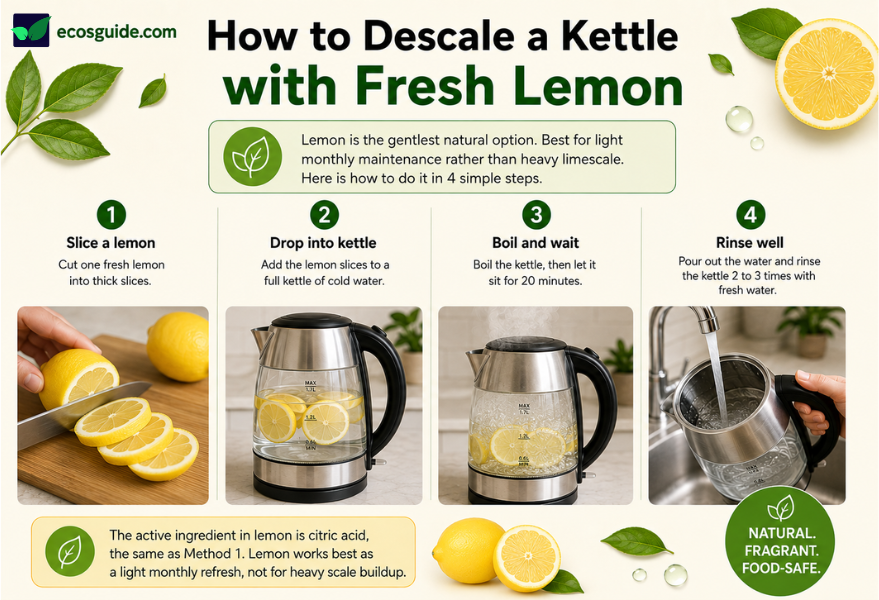
Should You Actually Use Vinegar?
You’ll find real disagreement on this. America’s Test Kitchen advises against vinegar for electric kettles, on the grounds that acetic acid can be corrosive and doesn’t fully remove limescale.
Meanwhile KitchenAid, Bon Appétit, Good Housekeeping, and most kettle manuals say it’s perfectly fine.
Both sides are partly right. Where the caution holds: prolonged vinegar contact, meaning overnight soaks or back-to-back weekly cycles, can degrade rubber gaskets and dull stainless finishes over time.
If you’re descaling with vinegar every single week, you’re being harder on the kettle than you need to be.
Where the concern is overstated: a 20-minute diluted-vinegar soak followed by rinse-and-two-boils is well within safe territory for the vast majority of electric kettles.
Consumer testing consistently shows it removes scale effectively without damage.
The practical bottom line: diluted vinegar used for a 20-minute soak with proper rinsing is safe for most electric kettles.
Citric acid is the better default, especially if yours is plastic-bodied. Vinegar is fine occasionally when it’s what you already have.
Both are far safer for you, and for your drains, than the commercial acid descalers sold as a professional alternative.
What to Skip: Five Kettle-Descaling Myths Retired
The internet is full of confident-sounding kettle hacks that don’t actually work. Here are five to retire.
Can You Descale a Kettle with Baking Soda Alone?
Chemically, no. Baking soda is alkaline, and so is limescale (calcium carbonate). You need an acid to dissolve alkaline scale. This is why baking soda alone can’t dissolve limescale. It’s brilliant for tea stains and burnt patches, but descaling is a different job.
Should You Mix Baking Soda and Vinegar to Descale a Kettle?
No. The two neutralize each other on contact and leave you with fizzy salty water. Whatever descaling power the vinegar had is instantly canceled by the base. This is the single biggest myth to retire from your kitchen.
Can You Use Coke or Sprite to Descale a Kettle?
Technically yes, because Coke contains phosphoric acid. Practically no, because you’ll then be scrubbing off a sticky sugar film. Plain citric acid or vinegar does the acid job without the mess, at a fraction of the cost.
Can You Use Bleach or Chlorine in a Kettle?
No, and please don’t. Bleach is corrosive to the heating element, has zero descaling power (it isn’t an acid), and it has no business near drinking water.
Can You Put a Kettle in the Dishwasher?
Never, especially not an electric kettle. The dishwasher’s heat and detergents will destroy the electronics and seals. For stovetop kettles the answer is still no.
Kettle-Material Specific Notes
Not all kettles descale the same way. Here’s the short version by material.
| Kettle type | Best method | Watch-outs |
| Stainless steel | Any acid works | Skip steel wool and salt-only soaks |
| Plastic-bodied | Citric acid strongly preferred | Vinegar smell absorbs into plastic |
| Glass | Any acid works | Skip all abrasives, glass scratches |
| Ceramic | Any acid works | Avoid thermal shock (cold water into a hot kettle) |
| Cordless with exposed heating coil | Any acid, slightly longer soak (30 min) | Scale sits directly on the coil, descale more often |
For stainless steel kettles with tea stains, burnt marks, or exteriors that need polishing, the methods above handle the interior.
For everything else, how to clean a stainless steel kettle walks through it. And on glass kettles: never use steel wool or abrasive pads, because they scratch. A soft sponge or microfiber cloth is all you need.
Don’t Forget the Filter (The Step Most People Miss)
Remove the mesh limescale filter at the spout, soak it separately in the same descaling solution for 10 minutes, rinse, and click it back in.
This is the step almost every article skips, and it’s the top reason people say I descaled my kettle but I still see white flakes when I pour.
The filter has been catching the scale you couldn’t see, and if you don’t clean it separately, it keeps releasing that scale into your next cup.
On most modern electric kettles, the filter is a small mesh screen inside the spout. It usually pulls out with a light tug or twists free.
Drop it into a bowl with the same solution, leave for 10 minutes, rinse well, and click it back into place.
How to Prevent Limescale in the First Place
A few small habits slow how quickly scale rebuilds:
- Boil only what you need. The Energy Saving Trust recommends this as one of the simplest kitchen energy wins, and it happens to slow scale buildup too. Less heated water, less residue.
- Empty the kettle after every use. Scale forms as water sits and evaporates.
- Give the interior a quick wipe with a soft cloth once a week.
- In hard-water areas, consider running your kettle water through a water filter jug first. This is the single highest-impact habit change if your local water is heavy.
- Drop a stainless-steel descaling ball or mesh into the kettle. It sits inside during boiling and attracts scale onto itself, so it collects on the wire instead of the element.
That last one is a prevention tool, not a descaler. It won’t undo existing buildup, but it slows how fast new scale forms in hard-water areas. There’s more on which one to pick below.
Are Eco-Descaler Tablets Worth It?
Same active ingredient, 5 to 10 times the price of plain powder.
On the ingredients panel, look for: single-ingredient citric acid, minimal or recyclable packaging, no added fragrance if it’s going near drinking water, and no dyes.
If a tablet ticks all four, it’s just citric acid in a compressed shape. Most don’t.
When to Stop Descaling and Just Replace the Kettle
Sometimes a kettle is beyond a rescue. If any of the following are true, no amount of descaling will bring it back:
- Persistent metallic taste even after two clean descales
- Visible pitting in the interior metal
- Rust or dark corrosion spots on the heating element
- Auto-shutoff no longer working reliably
- Visible plastic degradation (yellowing, cracking, warping around the element)
At that point, descaling is throwing good time after a lost kettle. If it’s time to replace, the best plastic-free electric kettles for when it’s time to replace is where I’d point you next.
Getting into a stainless or glass kettle at that stage is also the best time to break the plastic-body cycle for good.
The Eco Payoff
A descaled kettle uses less electricity per boil, lasts years longer, and keeps one small appliance out of landfill. The other piece is what leaves your sink.
Vinegar, citric acid, and lemon are all biodegradable and drain-safe. Some commercial acid descalers contain surfactants or quaternary ammonium compounds that persist in wastewater long after they’ve done their job.
The gentler methods aren’t a compromise. They’re just quieter about the same result.
My Honest Picks
My criteria: single-ingredient (or as close as possible), food-safe, drain-safe, minimal packaging, no added fragrance near drinking water. Three that pass.
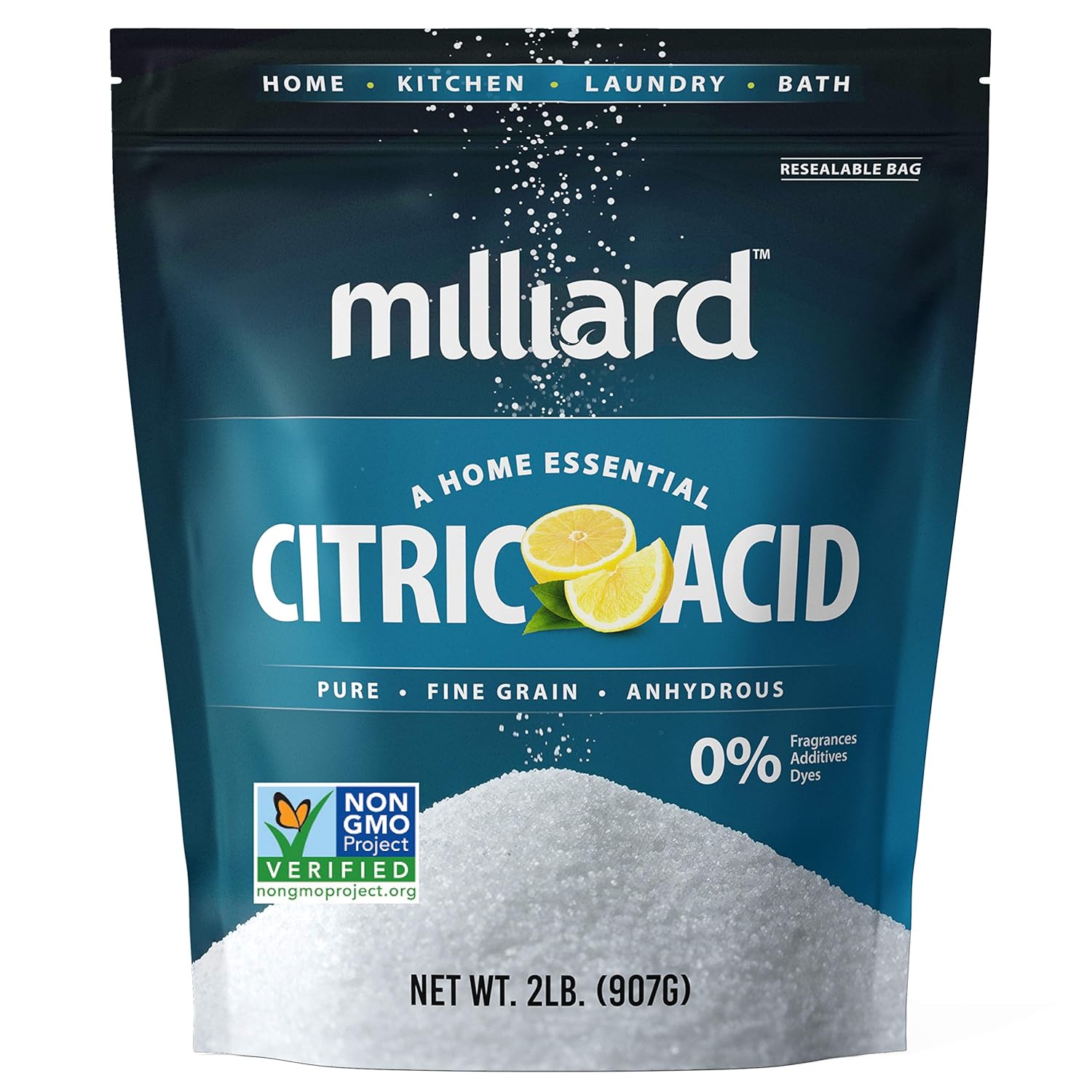
Single-ingredient, non-GMO project verified, food grade.
A 2-pound bag descales a hard-water kettle roughly monthly for a year, working out cheaper per descale than almost any tablet on the shelf.
Vinegar is what I usually reach for at home, so I haven’t personally used Milliard, but the ingredients, certifications, and reviews from eco-minded buyers tick every box I’d want in a citric acid pick.
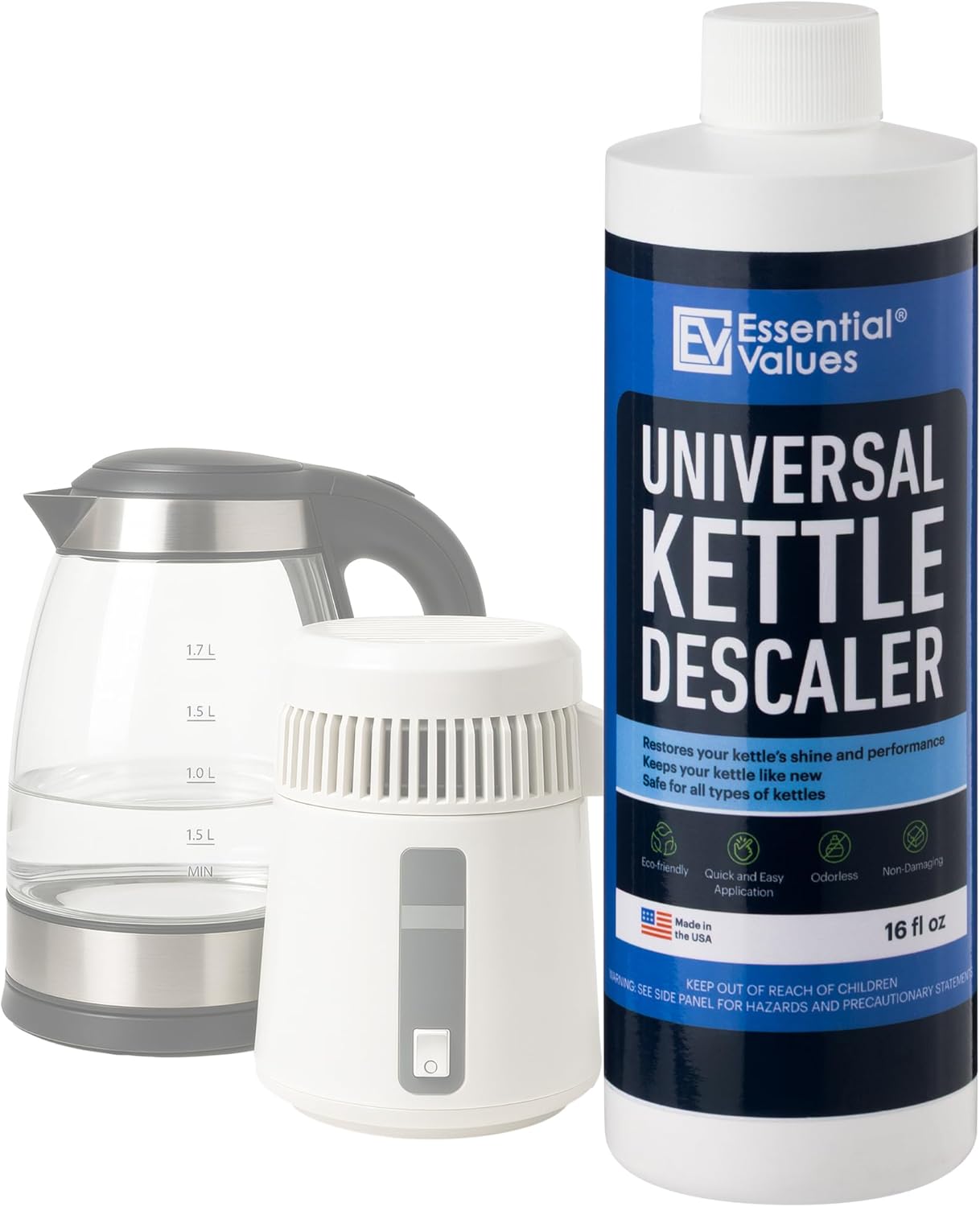
A liquid citric-acid-based descaler that pours straight in. Less economical than powder, but the ready-to-use format is nicer if you’re descaling a coffee machine and a kettle in one session.
I haven’t personally tested it, but the fragrance-free formula and reviews from eco-minded buyers check the right boxes for anyone who prefers a bottle over a bag.
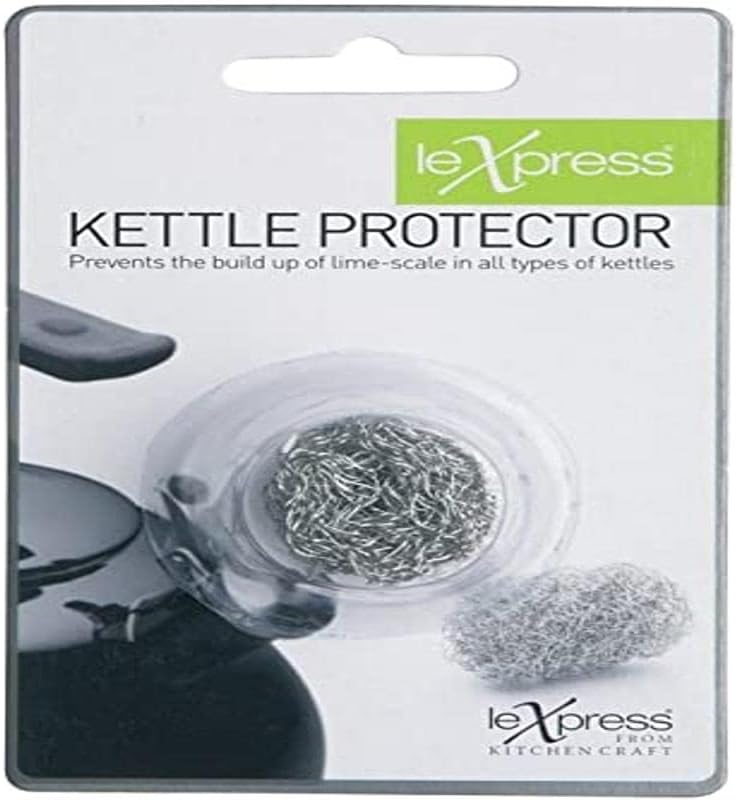
A prevention tool, not a descaler. A coil of stainless-steel wire sits inside the kettle while it boils, so scale attracts to it instead of the heating element.
Won’t remove existing scale, but paired with citric acid it noticeably slows how fast buildup returns in hard-water areas.
Untested by me personally, but the all-stainless design and reviews from hard-water households check the boxes: reusable for years, cleanable, no chemicals involved.
Final Thought
A clean kettle is one of the smallest changes I know of that pays back in every direction. Faster boils, better-tasting tea, more years of life out of the appliance, and less commercial chemistry going down the drain.
Whether you keep a bag of citric acid in the cupboard, a bottle of vinegar under the sink, or a lemon on the counter, the fact that you’re choosing thoughtfully already puts you ahead.
If you’d like a single-ingredient citric acid powder to try, Milliard’s food-grade version is where I’d start.
- Why Your Electric Kettle Needs Descaling
- How Often Should You Descale an Electric Kettle?
- What You’ll Need
- Method 1: Citric Acid (The Eco Pick)
- Method 2: White Vinegar (Cheapest, Works, But Smells)
- Method 3: Fresh Lemon
- Should You Actually Use Vinegar?
- What to Skip: Five Kettle-Descaling Myths Retired
- Kettle-Material Specific Notes
- Don’t Forget the Filter (The Step Most People Miss)
- How to Prevent Limescale in the First Place
- Are Eco-Descaler Tablets Worth It?
- When to Stop Descaling and Just Replace the Kettle
- The Eco Payoff
- My Honest Picks
- Final Thought
- Frequently Asked Questions
Find More Tips At:


Frequently Asked Questions
How do you descale an electric kettle?
Fill it halfway with equal parts water and white vinegar, boil, let it sit for 20 minutes, then rinse and boil fresh water twice. Or use 1 to 2 tablespoons of food-grade citric acid in a full kettle of water instead of the vinegar.
Is vinegar or citric acid better for descaling a kettle?
Citric acid is better as a default. It’s food-safe, odorless, and gentler on plastic and rubber gaskets. Vinegar works too but leaves a smell and needs the two-boil rinse to clear it fully.
Is limescale in an electric kettle harmful?
No. Limescale is calcium carbonate from hard water. The World Health Organization does not classify hard-water minerals as a health risk. Removing it improves taste and efficiency, not safety.
How often should you descale an electric kettle?
Every 1 to 3 months for typical water, every 2 to 6 weeks in hard-water areas, and every 6 to 12 months in soft-water areas. Let visible buildup guide you.
Can I use baking soda to descale my kettle?
No. Baking soda is alkaline and cannot dissolve limescale, which is also alkaline. It works only for tea stains or exterior burnt marks as a separate scrub.
Should I descale the filter too?
Yes. Remove the mesh limescale filter at the spout, soak it separately in the same descaling solution for 10 minutes, rinse, and click it back in. This is the step almost every article skips.
