
Are plastic kettles safe? Plastic kettles sold in the US and UK meet food-contact regulations and are legal to use, but peer-reviewed research shows they release microplastics and nanoplastics into boiling water.
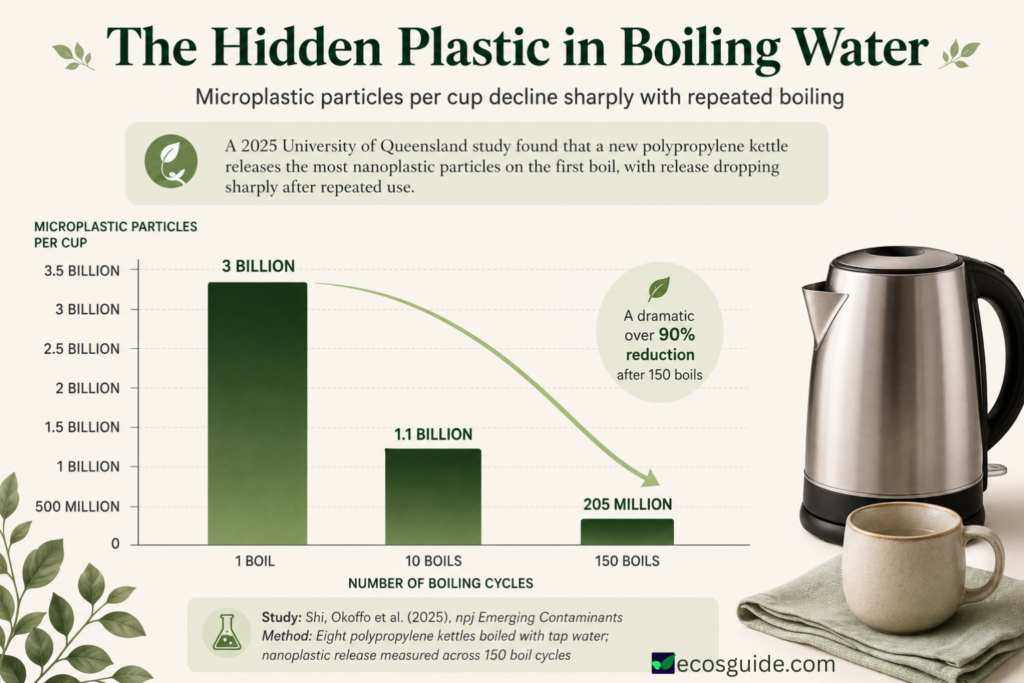
A 2025 University of Queensland study found a new plastic electric kettle sheds around 3 billion nanoparticles per 250 ml cup on its first boil, dropping to about 205 million per cup after 150 boils.
Long-term health effects of ingesting these particles are still being studied. To take the question off the table entirely, choose a kettle where no plastic touches the water or steam.
I’ve had a plastic kettle sitting on my counter for years, so I get why this question makes you wince.
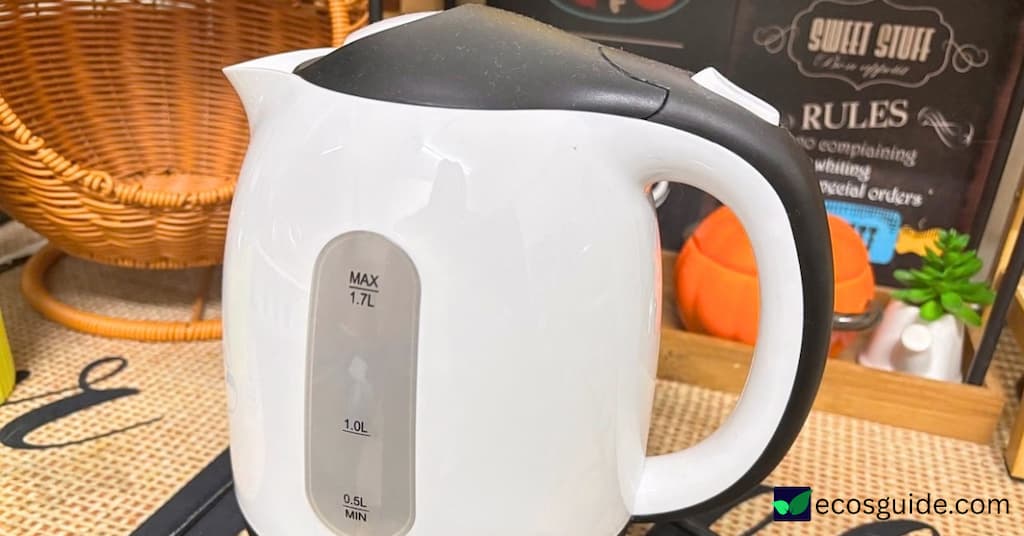
Below is the most honest answer I could put together on whether a plastic kettle is safe or not: what the science actually says, what it doesn’t, and three real options for what you can do next.
No fear, no guilt, no pressure.
Key Takeaways
- Plastic kettles sold in the US and UK meet food-contact safety standards and are lawful to sell, but “legal” is not the same as “risk-free.”
- Peer-reviewed research confirms plastic kettles release microplastics and nanoplastics into boiling water, with the highest release in the first several boils of a new kettle.
- The link between kettle-released microplastics and specific health outcomes has not been established. Research is ongoing.
- To remove the question entirely, choose a kettle with no plastic in the water or steam path, such as 304 stainless steel or borosilicate glass.
What the Science Actually Says About Microplastics from Plastic Kettles
The clearest evidence comes from a 2025 University of Queensland study published in the journal npj Emerging Contaminants.
Researchers tested eight polypropylene kettles and found that the first boil in a new kettle released almost 12 million nanoplastic particles per milliliter of water, which works out to roughly 3 billion particles in a standard 250 ml cup.
Even after 150 boils, the kettles were still shedding around 820,000 nanoparticles per milliliter, or roughly 205 million particles per cup. These are nanoscale particles: enormous counts of very small pieces.
This isn’t one alarming paper. Back in 2020, researchers at Trinity College Dublin published a peer-reviewed study in Nature Food showing that polypropylene, the same plastic used in most electric kettles, releases microplastics when exposed to hot water.
Their focus was infant feeding bottles, but the mechanism is the same one at play in a kettle: heat cycling breaks down the polymer surface and sheds particles.
The finding that hot water plus polypropylene equals particle release has now been replicated by independent teams.
What the science does not yet show is a direct causal link between kettle-released microplastics and specific diseases.
The World Health Organization’s position, from its 2019 assessment of microplastics in drinking water, is that current evidence does not indicate a widespread health risk at existing exposure levels, but calls for more research.
In plain English: we know the particles are in the water, we know we’re drinking them, and we don’t yet know what they do over decades.
What Plastic Are Kettles Made From? (And Why “BPA-Free” Misses the Point)
Most electric kettles are made from polypropylene, a food-grade plastic identified by resin code 5.
Some components, like handles or lid springs, may use polyoxymethylene or Tritan. Notably, kettles are not made from polycarbonate, the plastic BPA became famous for.
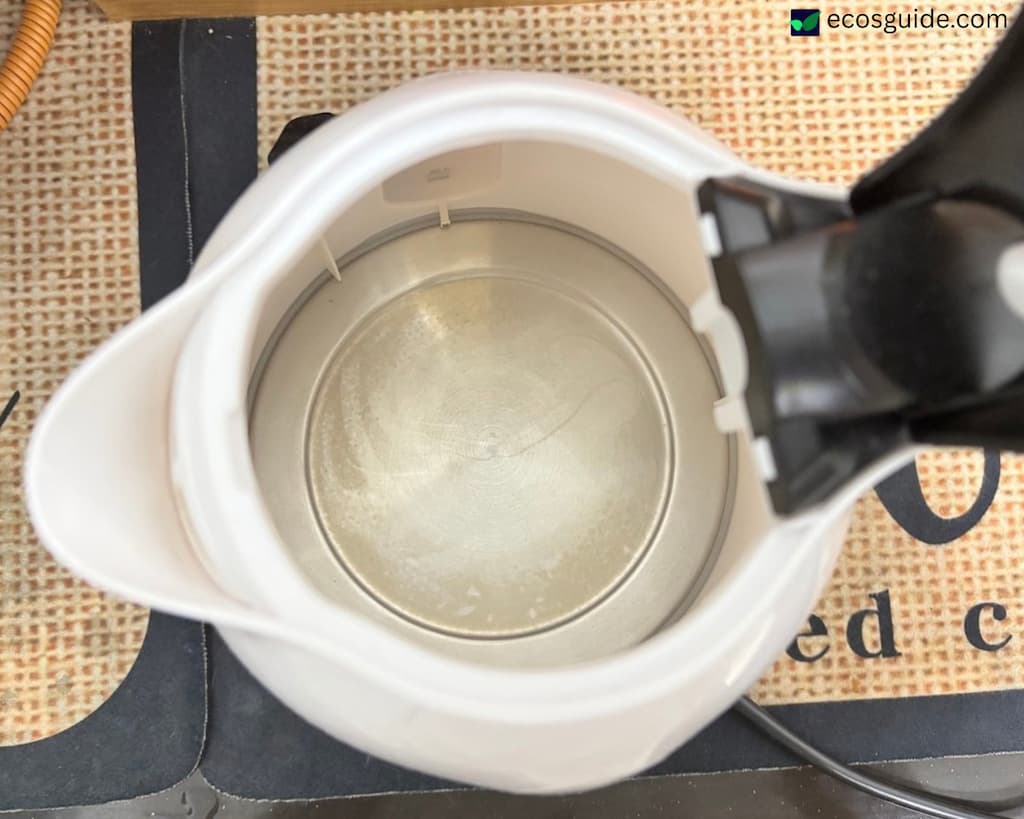
That distinction matters because it exposes the biggest myth on the shelf. BPA-free is not the same as plastic-free.
Most electric kettles are made from polypropylene, a different plastic from the BPA-containing polycarbonate the “BPA-free” label was originally designed to address.
In other words, “BPA-free” has technically always been true of your kettle, and it says almost nothing about the microplastic question.
The concern with polypropylene kettle safety is a completely different mechanism from BPA leaching.
What the 2025 research documented is polymer breakdown: the plastic surface softens and sheds particles under repeated boiling cycles, a temperature-driven pattern confirmed across common polypropylene food containers.
Chemical leaching and particle shedding are two separate safety questions, and passing one does not mean passing the other.
| Claim on the Box | What It Actually Means | What It Doesn’t Cover |
| BPA-Free | The plastic is not polycarbonate and contains no bisphenol A | Microplastic shedding under heat |
| Food-Grade | Approved for food contact at room temperature | Long-term nano-particle release during boiling |
| Plastic-Free Water Path | No plastic touches the water or steam inside the kettle | Nothing. This is the standard that actually addresses the microplastic question |
A quick note on “regrettable substitution.” When BPA got bad press, some products swapped in chemically similar cousins like BPS and BPF, only for later research to find comparable hormone-disrupting effects.
It’s a pattern worth remembering the next time a green sticker promises a clean answer.
Where Do These Microplastics Actually Go? (The Full-Cycle View)
I was standing at a storm drain one afternoon after a downpour, watching bits of plastic get swept along with the runoff.
Bottle caps, food wrappers, small pieces I couldn’t recognize anymore. It stayed with me. That evening, boiling water for tea, I looked at my kettle differently. What was I quietly adding to the water every single day, and where did it all go after I drank it?
Some of what we ingest is absorbed by the body. Some passes through and ends up in wastewater.
This is where the full picture gets uncomfortable: most municipal wastewater treatment plants are not designed to capture nanoscale particles.
There is a second layer that gets overlooked. Most plastic kettles have a heating element bonded directly to plastic housing, which means at end of life they cannot be separated by standard municipal recycling.
They go to landfill, where the plastic continues to break down under sun and heat for years. Stainless steel and glass, by contrast, are both fully and infinitely recyclable.
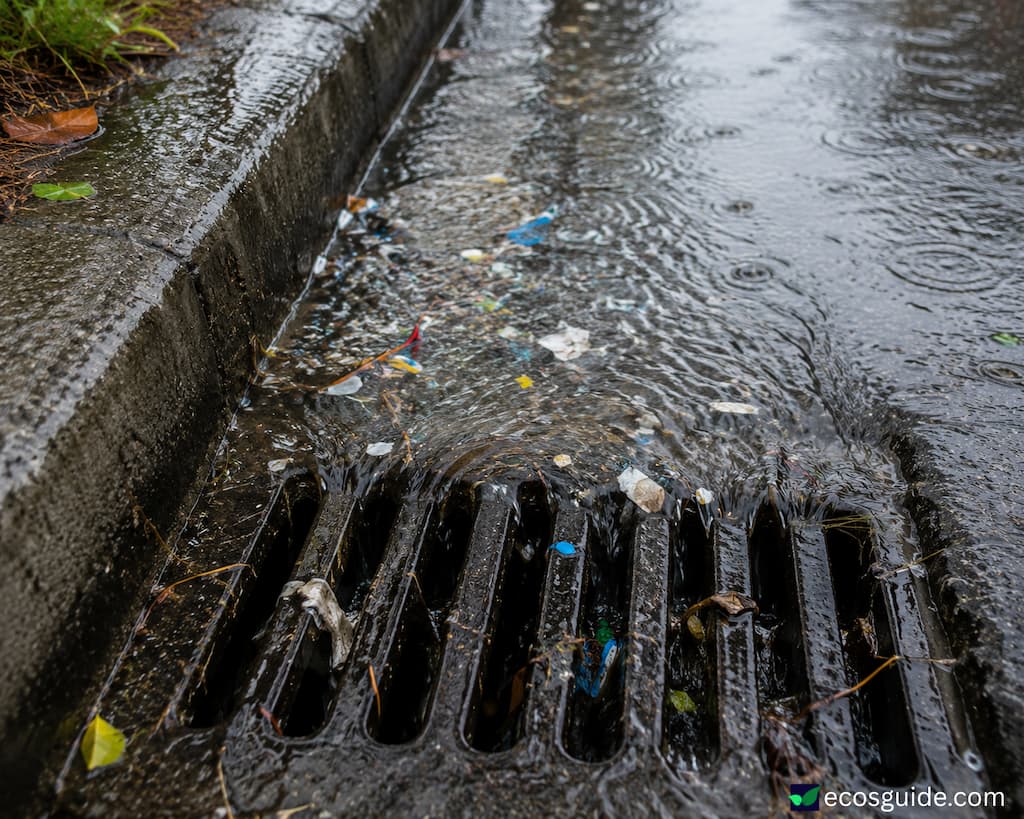
Illustration generated with AI for reference.
Should You Actually Worry About This?
Context matters here. The 3-billion-particles number is striking, but a kettle is one of many household sources of microplastic exposure, not the only one.
Polypropylene teabags release around 1.2 billion particles per milliliter of hot water.
Plastic-lined takeaway cups, food storage containers, cutting boards, and single-use water bottles all contribute. Isolating the kettle and calling it fixed misses the bigger picture.
There is also a genuinely counterintuitive finding that deserves attention. A 2024 study in Environmental Science & Technology Letters found that boiling tap water can remove at least 80 percent of the microplastics already in it, because minerals like calcium carbonate co-precipitate with the plastic particles and trap them.
So the boiling process itself is helpful, as long as the kettle doing the boiling isn’t adding new particles back in.
What to Do About It: 3 Practical Paths
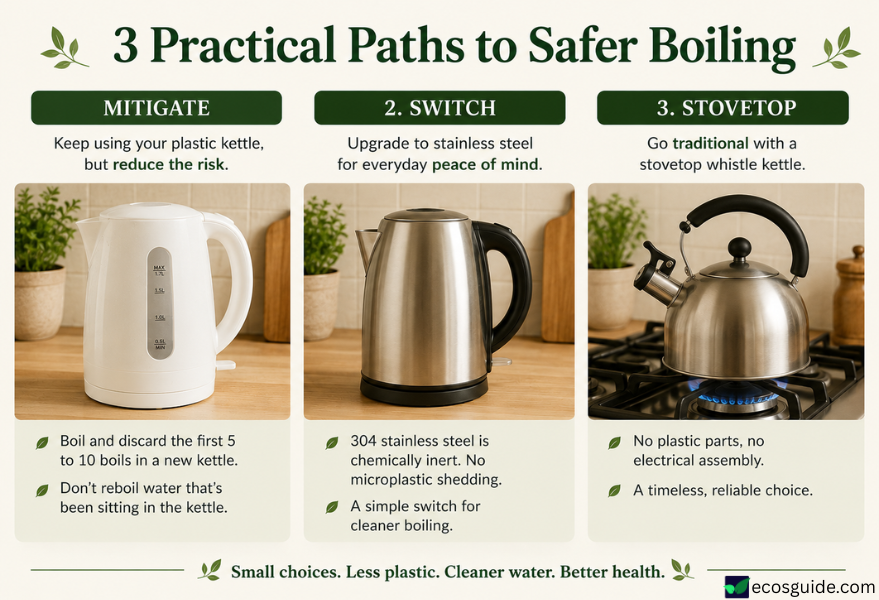
Path 1: Keep Your Plastic Kettle, but Reduce the Exposure
If you’re not in a position to replace your kettle right now, you’re not stuck. The Okoffo research points to a few small habits that meaningfully cut down on the particles reaching your cup.
Boil and discard the first 5 to 10 boils in any new plastic kettle. Rinsing before first use is common advice, but it isn’t enough. Repeated hot-water flushing is meaningfully more effective at clearing the loose surface particles left behind from manufacturing.
Don’t reboil water that has been sitting in the kettle. Every reboil is a fresh exposure, so treat what you boil as a single-use pour.
Descale regularly, particularly in hard water areas. Counterintuitively, the mineral coating that forms in hard-water kettles appears to reduce particle release, and a natural descaling routine using a gentle descaler like baking soda is a low-effort habit that helps.
Finally, replace the kettle if you see cracks, discoloration, or a persistent plastic taste. Those signal the polymer is breaking down.
Path 2: Switch to a Kettle With No Plastic in the Water Path
If you’re ready to switch, the goal is a kettle where no plastic touches the water or the steam. The safest kettle materials for boiling water are 304 stainless steel and borosilicate glass.
Both are chemically inert at boiling temperatures and do not shed microplastic particles.The catch is that “stainless steel” on the box isn’t the same as “no plastic in the water path.”
Many stainless kettles still hide plastic components: a plastic water gauge on the side, a plastic filter in the spout, plastic on the underside of the lid where steam condenses and drips back in. Buying criteria matters as much as the material label.
If you want a starting point for the plastic kettle vs stainless steel comparison, the 5 plastic-free kettles I trust for my own kitchen are all vetted for a fully plastic-free water path.
Once you have one, how to clean a stainless steel kettle without harsh chemicals walks through the maintenance.
Path 3: Use a Stovetop Kettle Instead
The simplest kettle is still an option. A stovetop kettle has fewer parts and fewer places for plastic to hide.
Widely available in 304 stainless steel or borosilicate glass, it removes the electrical assembly entirely and leaves you with just metal, water, and heat.
The trade-off is speed. A stovetop kettle takes three to four times longer to boil than an electric one, and the ritual of a whistle and a hob isn’t for everyone.
Where a stovetop kettle really earns its place is in a home that already runs on gas or induction, and in kitchens where you want the simplest possible material story. If your morning tea can wait an extra few minutes, this is the cleanest answer of the three.
What About Glass and Ceramic Kettles?
Glass
Borosilicate glass is chemically inert at boiling temperatures, so it doesn’t shed microplastics. The practical concern is fragility. It’s worth thinking carefully in a household with small children unless the kettle is double-walled.
Ceramic
Rare in electric form, more common on the stovetop. Ceramic is generally safe, but check for lead-free glaze certification, especially with imported models where the standards can be inconsistent.
Both borosilicate glass and 304 stainless steel are considered safe kettle materials for boiling water because they are chemically inert and do not shed microplastic particles under repeated heat.
| Material | Sheds Microplastics? | Chemically Inert at Boiling? | Watch Out For | Best For |
| Polypropylene (plastic) | Yes, especially in early boils | No, releases nanoplastics under heat | New-kettle burst release, cracks, plastic taste | Budget or short-term use only |
| 304 Stainless Steel | No | Yes | Hidden plastic in lid, spout filter, or water gauge | Everyday use, families, most kitchen |
| Borosilicate Glass | No | Yes | Fragility, hidden plastic in base or lid | Style-first kitchens, adult households |
| Ceramic | No | Yes | Lead in imported glazes, mostly stovetop only | Tea rituals, slower morning routines |
Final Thought
Somehow it always comes back to water. What we drink, what we boil, what runs from our sinks and out into rivers and eventually back to us.
This isn’t a fear pitch. Nobody knows the full picture yet, and I’m not going to pretend I do either.
What I know is that some choices in a kitchen aren’t emergencies, they’re quiet decisions that add up.
If your plastic kettle is working and you’d rather understand and mitigate than replace, that is a completely valid answer. If you’re ready to take the question off your counter for good, see my current kettle picks and go from there.
Small kitchen choices matter. Not because they save the planet in one move, but because they compound quietly, in your body and in the water outside it.
- What the Science Actually Says About Microplastics from Plastic Kettles
- What Plastic Are Kettles Made From? (And Why “BPA-Free” Misses the Point)
- Where Do These Microplastics Actually Go? (The Full-Cycle View)
- Should You Actually Worry About This?
- What to Do About It: 3 Practical Paths
- What About Glass and Ceramic Kettles?
- Final Thought
- Frequently Asked Questions
Find More Tips At:


Frequently Asked Questions
Do plastic kettles cause cancer?
There is no established causal link between plastic kettles and cancer. Research has confirmed that plastic kettles release microplastics and nanoplastics into boiling water, but no health authority has classified those particles as a specific cancer risk. Long-term effects of chronic exposure are still being studied.
Are BPA-free plastic kettles safe?
BPA-free plastic kettles are legal to sell and meet food-contact regulations, but “BPA-free” does not mean “microplastic-free”: the two are separate safety questions. Most electric kettles are made from polypropylene, which has never contained BPA in the first place. The 2025 research on microplastic shedding applies to BPA-free kettles just the same.
What is the safest kettle material?
The safest kettle materials for boiling water are 304 stainless steel and borosilicate glass, because both are chemically inert at boiling temperatures and do not shed microplastic particles. When shopping, verify that the water path (interior, lid underside, spout filter, water gauge) is fully free of plastic components, not just the outer body.
Should I throw out my plastic kettle right now?
Not necessarily. If replacing it isn’t practical right now, you can meaningfully reduce your exposure by boiling and discarding the first several boils in a new kettle, avoiding reboils, and descaling regularly. Consider replacing when you see cracks, discoloration, or a persistent plastic taste.
How can I tell if my kettle has plastic touching the water?
Do a quick inspection with the kettle empty. Look at the underside of the lid where steam condenses, the spout for a plastic filter, the side for a plastic water gauge or window, and the interior base for plastic joints or covers. Any of these means plastic touches the water or steam path.
Do plastic kettles taste different from stainless steel
Many people report a faint plastic taste, especially in the first several boils of a new plastic kettle. That taste usually fades but can return if the kettle is degrading. A persistent plastic taste over months is often a signal the polymer surface is breaking down more quickly, and worth taking as a cue to replace.
