
You clean the dishwasher with vinegar and baking soda by running two separate cycles, vinegar first, then baking soda, never mixed together.
Place 1 to 2 cups of distilled white vinegar in a bowl on the top rack and run one hot empty cycle. Then sprinkle 1 cup of baking soda across the bottom for a short second cycle.
Mixed together in one wash, the two neutralize into salty water and do nothing useful. The order is the whole trick.
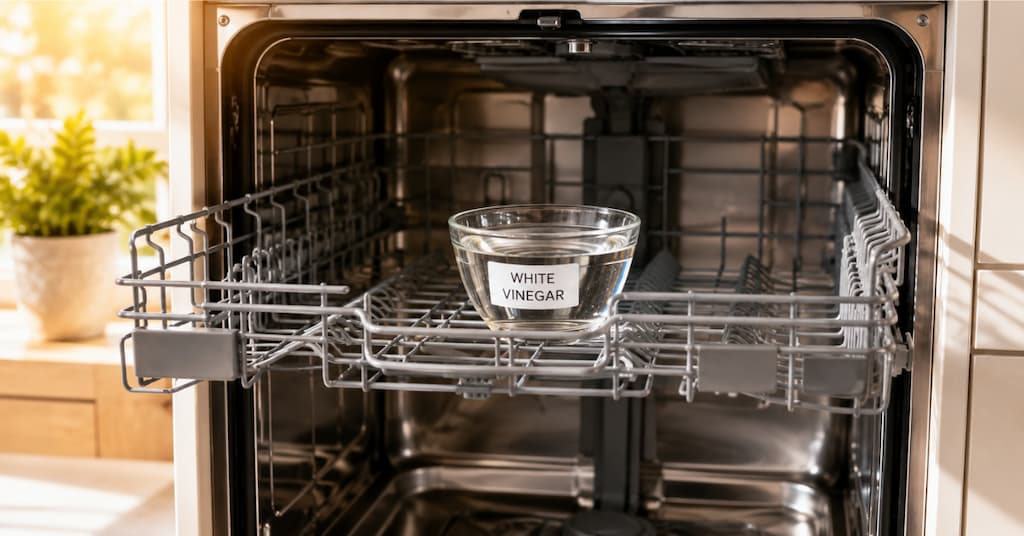
Illustration generated with AI for reference.
Commercial dishwasher cleaners are designed to break down buildup and residue, but their ingredients ultimately go down the drain with the wastewater after the cleaning cycle.
For readers who prefer a simpler and eco-friendly approach, vinegar and baking soda can be useful pantry alternatives for certain cleaning tasks, provided they are used separately and are compatible with the dishwasher manufacturer’s guidance.
I don’t have a dishwasher in my own kitchen, but I’ve researched this method thoroughly from manufacturer guides and food-science sources.
The ingredients photographed here are the same ones on my counter.
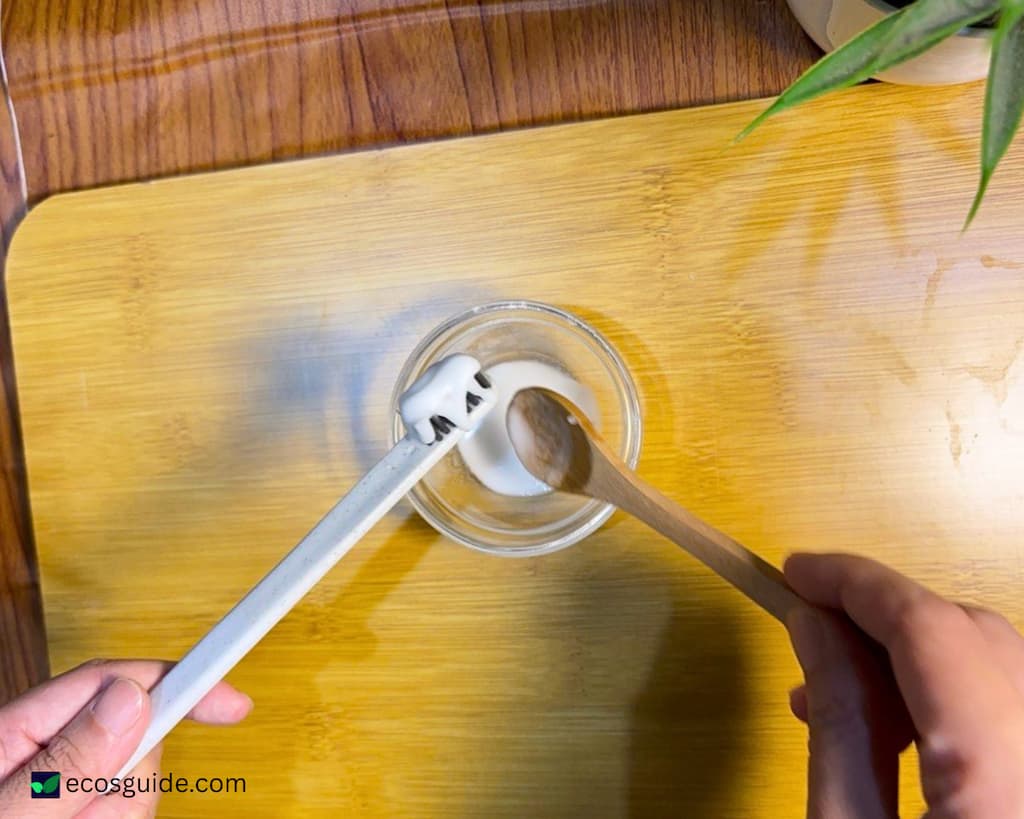
I’ve also included a photo showing how to make the baking soda paste for stubborn grime, so you can see exactly what the mixture should look like before using it for manual cleaning.
Key Takeaways
- Run vinegar and baking soda as two separate cycles, vinegar first on the top rack, then baking soda across the bottom of the tub.
- Clean the filter and spray arms before either cycle. Most persistent dishwasher smells trace to a clogged filter, not a dirty tub.
- A monthly deep clean covers most households; every eight to twelve weeks is enough for lighter use.
- KitchenAid, Whirlpool, Bosch, and Miele all caution against frequent vinegar use. Food-grade citric acid powder is the manufacturer-friendly alternative for cautious brands.
Why You Should Never Mix Vinegar and Baking Soda in the Dishwasher
Mixing vinegar and baking soda in a dishwasher cycle produces sodium acetate, water, and carbon dioxide, essentially salty water, which has no cleaning power.
Here is what happens in plain terms. Baking soda is a base at pH 9, good at neutralizing grease and cutting odor. Vinegar is an acid at pH 2, good at breaking down mineral deposits from hard water.
Combine them, and the acid and base cancel each other out. You get a brief fizz, some carbon dioxide, and a shallow tray of sodium acetate solution. Nothing scours. Nothing descales.
As food scientist Ruojie Vanessa Zhang, PhD, of the University of Missouri, explained to Simply Recipes, using baking soda and vinegar separately maximizes their individual cleaning strengths.
Chemists interviewed by The Kitchn and other mainstream cleaning guides reach the same conclusion. Everyone agrees. Almost no one leads with it.
If you want the longer explanation of why the two ingredients neutralize each other into essentially salty water, I have written it out in more detail.
What matters here is what comes next: two separate cycles, in the right order, do what one mixed cycle never can.
What You Need Before You Start
Distilled white vinegar with 5% acidity is the standard grade for dishwasher cleaning, while industrial-strength cleaning vinegar above 5% can damage rubber components on some models.
Stick with the plain distilled kind unless you know your dishwasher tolerates the stronger stuff.
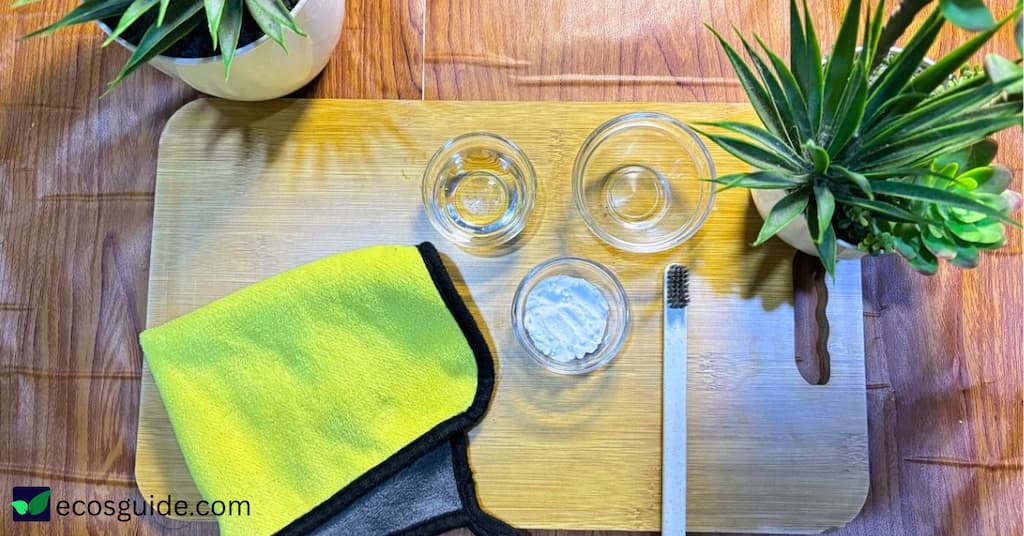
Here’s everything laid out on my counter before I walk you through it.
- Distilled white vinegar, 1 to 2 cups for the main cycle plus half a cup for the door seal
- Baking soda, 1 cup for the second cycle plus a small pinch for filter paste
- A dishwasher-safe glass or ceramic bowl for the vinegar
- An old soft-bristle toothbrush for gasket and spray arms
- Toothpicks for clearing spray arm holes (optional)
- A microfiber cloth
Step 1: Clean the Filter First
A dishwasher filter is the removable cylindrical or flat mesh unit at the base of the tub that captures food particles during the wash cycle, and monthly cleaning is the recommended maintenance interval.
This is the single highest-impact step in the routine. Most persistent dishwasher smells trace back to a clogged filter, not a dirty tub.
Locate the filter at the bottom of the dishwasher, usually a twist-lock cylinder in the center-back of the tub.
Twist and lift it out. Rinse under warm running water and scrub gently with a soft-bristle toothbrush to work debris out of the mesh.
If the filter is heavily coated in grease, drop it in a bowl of warm water with a squeeze of dish soap for five minutes before scrubbing.
For stubborn grime, apply a light paste of baking soda and water to the toothbrush. This is baking soda on its own, doing abrasive work, not the fizzing volcano combo.
Something like this — thick enough to cling to the bristles but not runny.
Rinse thoroughly, twist the filter back into position, and check that it locks in place before you close the door.
Step 2: Clear the Drain and Spray Arms
With the filter still out, run a damp cloth around the sump area at the bottom of the tub.
Lift out any visible debris, broken glass, seeds, bits of pasta, anything that has fallen through and lodged around the drain.
Now check the spray arms. Most dishwashers have one under each rack, and both can usually be twisted off by hand. Hold each arm up to the light and look at every hole around the edges.
If any are blocked with mineral scale or food particles, use a toothpick to gently clear them out, then rinse under warm water and reattach.
This is the step most people skip. It is the difference between a dishwasher that looks clean and a dishwasher that actually cleans.
Step 3: Run a Vinegar Cycle
A vinegar cycle is an empty dishwasher wash with 1 to 2 cups of distilled white vinegar in a dishwasher-safe bowl on the top rack, run on the hottest setting with no detergent.
This is what 1 to 2 cups looks like measured out.
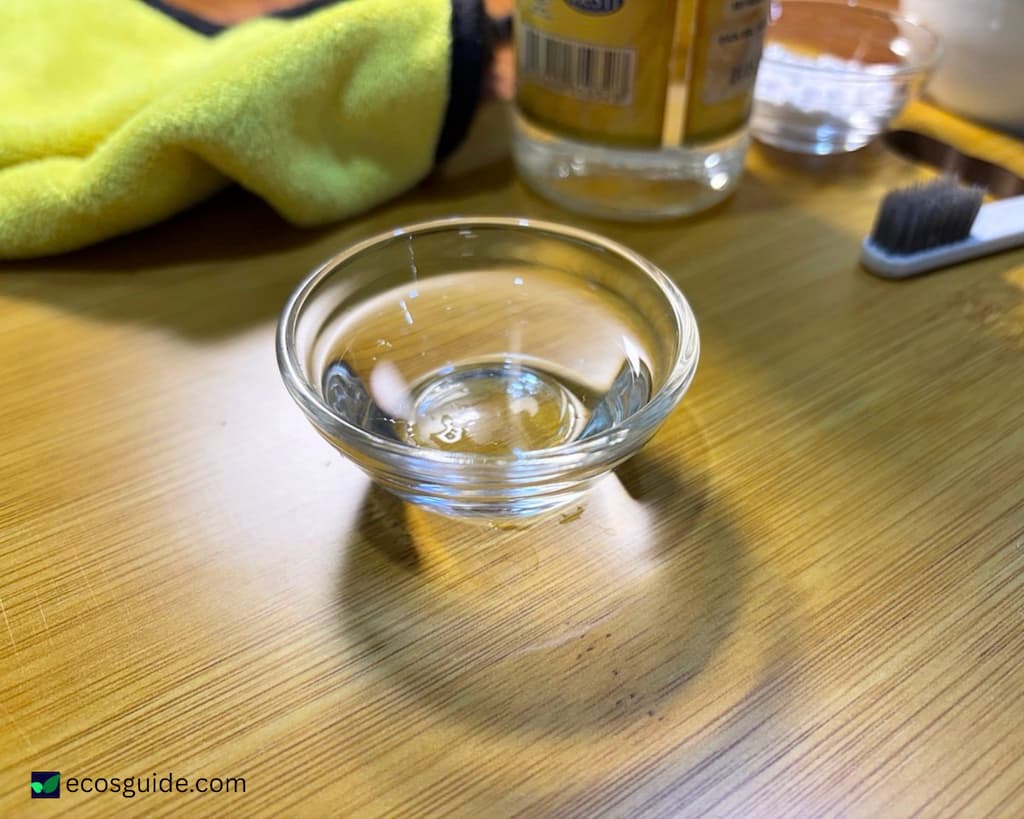
Pour 1 to 2 cups of distilled white vinegar into a glass or ceramic bowl and place it upright on the top rack.
Not in the detergent compartment, not on the tub floor. Some manufacturer support pages recommend the bottom rack, but most published guides put the bowl on top.
The reasoning is simple: keeping vinegar away from the detergent dispenser prevents unnecessary rubber contact, and dispersing from a higher position spreads it across more of the interior.
Confirm the dishwasher is empty of dishes and detergent, then run the hottest cycle available.
Turn heat-dry off. The next step works better on a slightly damp interior. When the cycle finishes, the interior should already look and smell noticeably fresher.
Step 4: Run a Baking Soda Cycle
Open the dishwasher when the vinegar cycle finishes. The interior should still be damp from the wash, which is exactly what you want.
Measure out 1 cup on your counter first, so you can sprinkle it evenly instead of dumping. Then scatter it across the bottom of the tub in a light, even layer.
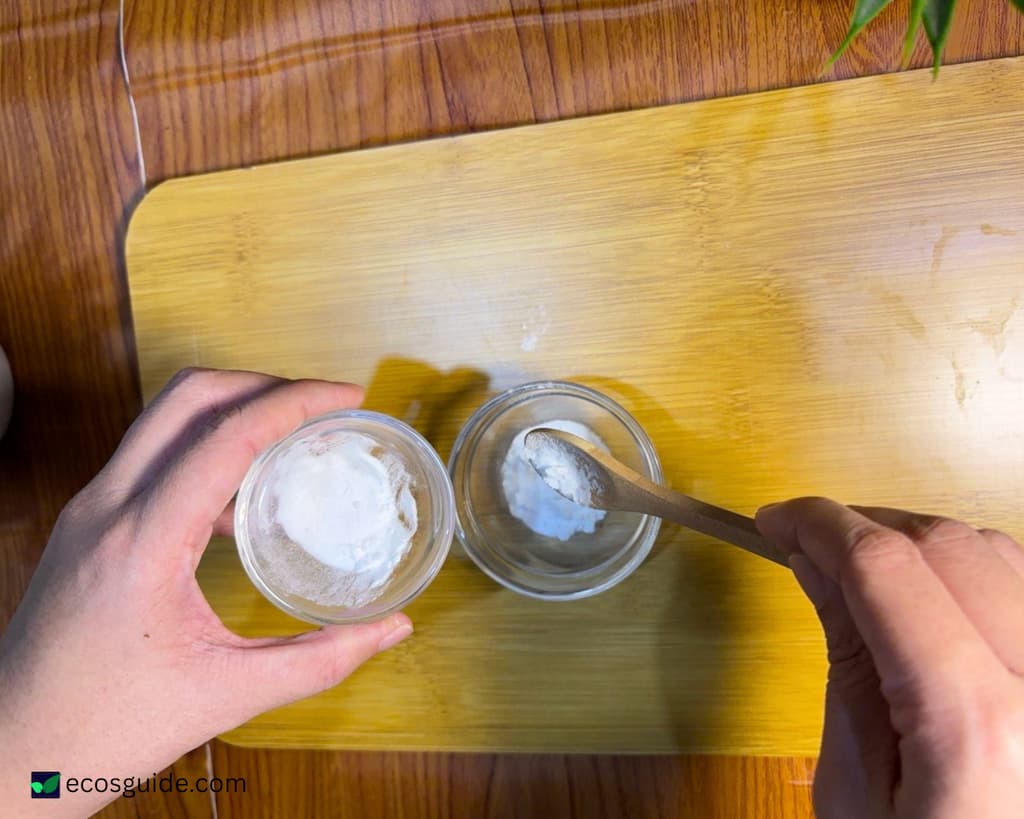
Do not pile it up in one spot. A gentle scatter gives the baking soda room to dissolve and circulate.
Close the door and run a short hot cycle, whatever your model calls “Express Wash,” “Quick Wash,” or something similar.
For a little extra polish, leave the door propped open at the end and let the interior air dry.
This is why the two cycles run separately. The vinegar has already drained by the time the baking soda goes in, so nothing neutralizes anything.
Each cycle gets its own run of the machine, and each one does what it was made to do.
Step 5: Clean the Gasket and Door Seal
Mix half a cup of white vinegar with 3 cups of warm water in a bowl. This is a dilute case, not the myth: the vinegar is being cut down, not reacting with an alkali.
It becomes a gentle antibacterial wipe.
Dip an old soft-bristle toothbrush into the solution and work it slowly along the folds of the rubber gasket that lines the door.
Pay attention to the corners and the bottom lip of the seal. Those are the mold traps, the spots where dark patches creep in unnoticed.
The door gasket is an area worth paying particular attention to because its folds can trap moisture, food residue, and grime.
Wipe the gasket thoroughly, especially around the corners and lower edge of the seal, and dry it afterward to help prevent buildup and unpleasant odors.
How Often Should You Clean Your Dishwasher This Way?
A monthly deep clean is the recommended maintenance frequency for a dishwasher in average use.
And households that run fewer than three loads a week can extend this to every eight to twelve weeks. Your dishwasher and your water bill will both thank you.
For everyday upkeep, a 30-second habit goes a long way. After each load, glance at the filter for obvious debris and wipe the rubber door seal with a damp cloth.
Those two small moves prevent most of what a monthly deep clean has to fix.
The signs you are overdue are hard to miss: cloudy glassware, standing water in the tub, or a musty smell that lingers after a cycle. Any one of them means it is time.
When Vinegar Isn’t Safe: Manufacturer Warnings and What to Use Instead
Vinegar works well, but not every dishwasher manufacturer endorses it. The honest truth is worth hearing before you make it a monthly ritual.
KitchenAid’s own cleaning guide is direct about it: “Vinegar is an acid, and using it too often could damage your dishwasher.”
Whirlpool, which owns KitchenAid, gives the same caution and points owners toward its Affresh cleaner.
Bosch is stronger still: the company explicitly advises against vinegar in its washing machines because the acidity can degrade rubber parts over time, and takes the same stance on its dishwashers.
Miele’s manuals stay silent on vinegar and point owners to Miele’s own dishwasher cleaner.
The concern is real but modest. Because manufacturers differ in their guidance, check your dishwasher’s manual before using vinegar.
If vinegar isn’t recommended for your model, use the manufacturer’s recommended dishwasher cleaner or descaler instead.
Heavy or weekly use over years can accelerate wear on rubber gaskets and seals, particularly on the door and around the drain hose.
If you want to sidestep the issue, food-grade citric acid powder is the manufacturer-friendly substitute.
Sprinkle a quarter cup across the bottom of an empty dishwasher and run a hot cycle.
It descales the same mineral buildup that vinegar targets, without the acid strength that worries manufacturers.
Several dishwasher brands recommend citric acid or citric-acid-based descalers directly. Same pantry-eco approach, minus the manufacturer caveat.
What’s Actually in Commercial Dishwasher Cleaners (And Where It Goes When You Rinse)
The EPA Safer Choice program is a US federal certification that identifies household cleaners meeting environmental and health-based ingredient standards, and commercial dishwasher cleaners are certified on a product-by-product basis.
It is a useful lens for reading the label on any bottle.
Most conventional dishwasher cleaners lean on some combination of the following.
Sodium hypochlorite (bleach) cuts through biofilm well but is a common water-system pollutant at scale.
Sodium tripolyphosphate was a historic driver of algal blooms and has been phased out of most modern formulations, though some older products still carry it.
Synthetic surfactants make up the bulk of the cleaning power in many formulas, and while modern ones are often biodegradable, not all of them are.
Sodium percarbonate, sometimes called oxygen bleach, is one of the more benign options: it breaks down into sodium carbonate, hydrogen peroxide, and oxygen.
Compare that to what goes down the drain when you run a vinegar and baking soda pair. Acetic acid is fully biodegradable.
Sodium bicarbonate is essentially inert in wastewater. Citric acid, if you use it instead, breaks down completely too. The EPA’s Safer Choice program is worth a look if you want to see how a specific commercial cleaner stacks up against the pantry alternatives.
When Vinegar and Baking Soda Aren’t Enough
Sometimes a dishwasher struggles harder than any monthly clean can fix.
Hard-water film that will not clear after two full cycles.
Mold at the door seal that reappears within a week. A persistent smell that lingers no matter what.
If that is what you are dealing with, the question is not how you are cleaning the machine. It is what you are washing dishes with day-to-day.
The detergent inside your dispenser has a much bigger impact on hard-water residue and odor than any monthly maintenance routine.
If you have not thought about yours in a while, take a look at the eco dishwasher detergents I trust, the ones that clean well without leaving synthetic residue behind. It is often the missing piece.
A Cleaner Dishwasher, Kinder Waterways
Separately, not together. That is the whole trick, and it comes back to something simple: acid does one job, base does another, and the second you mix them, you have neither.
Every commercial dishwasher cleaner has a fate downstream, and the pantry version has almost none.
If a smell or a film keeps coming back after this routine, that is usually a sign to look at the eco dishwasher detergents I trust rather than the cleaning method.
For more of the same, my guide to cleaning a gas stove top naturally picks up where this one leaves off.
- Why You Should Never Mix Vinegar and Baking Soda in the Dishwasher
- What You Need Before You Start
- Step 1: Clean the Filter First
- Step 2: Clear the Drain and Spray Arms
- Step 3: Run a Vinegar Cycle
- Step 4: Run a Baking Soda Cycle
- Step 5: Clean the Gasket and Door Seal
- How Often Should You Clean Your Dishwasher This Way?
- When Vinegar Isn’t Safe: Manufacturer Warnings and What to Use Instead
- What’s Actually in Commercial Dishwasher Cleaners (And Where It Goes When You Rinse)
- When Vinegar and Baking Soda Aren’t Enough
- A Cleaner Dishwasher, Kinder Waterways
- Frequently Asked Questions
Find More Tips At:


Frequently Asked Questions
Can you mix vinegar and baking soda in the dishwasher?
No. When you mix them, the acid and base neutralize each other into sodium acetate, water, and carbon dioxide, essentially salty water with no meaningful cleaning power. Run them as two separate cycles: vinegar first, then baking soda.
Does vinegar damage the rubber seals in a dishwasher?
Occasional monthly use is generally safe on most modern dishwashers. Regular or heavy use over years can degrade rubber gaskets. KitchenAid and Whirlpool caution against overuse, and Bosch and Miele do not endorse vinegar for their dishwashers at all. Food-grade citric acid powder is a gentler alternative if your model is one of the more cautious brands.
How often should you clean a dishwasher with vinegar and baking soda?
Once a month for households that run the dishwasher most days. Every eight to twelve weeks if you use it less than three times a week. Move it up sooner if you notice a smell, cloudy glassware, or standing water in the tub.
Can I use apple cider vinegar or lemon juice instead of white vinegar?
Apple cider vinegar works but its residual sugars can leave a faint film. Lemon juice is too weak and too variable to rely on. Distilled white vinegar at 5% acidity is the standard for a reason. Food-grade citric acid powder is a better substitute than either.
Is it safe to use vinegar in a dishwasher with a septic system?
Yes. Vinegar (dilute acetic acid) and baking soda (sodium bicarbonate) are both septic-safe in the quantities used here. They are actually gentler on septic bacteria than most commercial dishwasher cleaners, which often contain bleach.
Do I still need dishwasher cleaner tablets, or is this enough?
For most households, monthly vinegar and baking soda maintenance is enough. Tablets like Affresh, Finish, or Cascade can help in very hard-water areas or on a long-neglected machine, but they are not a monthly necessity if you keep up with the pantry version.
