
Is baking soda the same as washing soda?
No, baking soda and washing soda are not the same.
Baking soda is sodium bicarbonate, a mild powder with a pH of around 8 that is gentle enough to be food-safe.
Washing soda is sodium carbonate, a much stronger, caustic powder with a pH of around 11 that works as a heavy-duty degreaser.
You can handle baking soda with your bare hands for everyday kitchen cleaning, but washing soda is best kept away from skin, food, and delicate surfaces.
When I think about what leaves my kitchen sink every day, I don’t picture chemistry.
I picture where it all goes once the water carries it off. That is why I keep reaching for the gentler powder whenever it will do the job.
It feels like a small, honest choice, and I believe small kitchen choices are where real change starts. So let’s clear up the confusion, starting with what actually makes these two powders different.
Key Takeaways
- Not the same. Baking soda is mild, food-safe sodium bicarbonate (pH 8); washing soda is caustic sodium carbonate (pH 11).
- Swap one way only. Baking soda can sub for washing soda in cleaning (just weaker), never in food. Bake it at 400°F (200°C) for 30 to 60 minutes to convert it.
- Borax is a third powder. Stronger than baking soda (pH 9.5), good for cleaning and laundry, but not food-safe.
- Match it to the job. Baking soda for gentle, everyday cleaning; washing soda for heavy grease, kept off aluminum, nonstick, and unsealed wood.
What’s the Actual Difference Between Baking Soda and Washing Soda?
The difference begins at the chemical level.
Baking soda is sodium bicarbonate (NaHCO₃), and washing soda is sodium carbonate (Na₂CO₃).
That one difference in structure changes how each powder behaves, how strong it is, and how safely you can handle it.
Washing soda is essentially what baking soda becomes when it loses water and carbon dioxide, which leaves behind a more alkaline, more aggressive cleaner.
Baking soda is gentle and food-safe, ideal for deodorizing and light scrubbing inside kitchen appliances, while washing soda is a stronger degreaser and water softener best saved for heavy grease and laundry.
| Component | Baking soda | Washing soda |
| Chemical name | Sodium bicarbonate (NaHCO₃) | Sodium carbonate (Na₂CO₃) |
| pH | About 8 (mildly alkaline) | About 11 (strongly alkaline, caustic) |
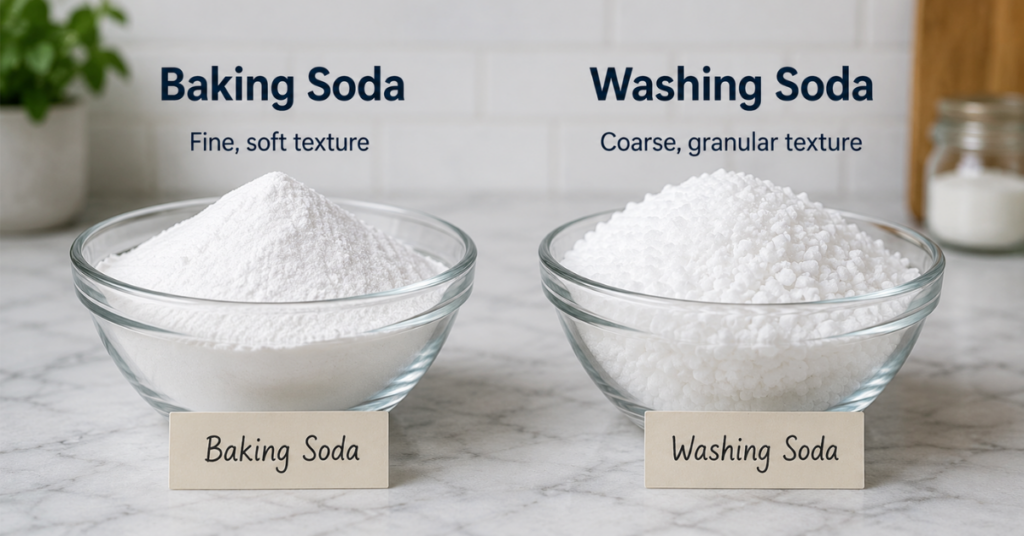
| Texture | Fine, soft powder | Coarse, grainy crystals |
| Food-safe? | Yes (FDA GRAS) | No, not edible and caustic |
| Best at | Deodorizing, gentle scrub, leavening | Cutting heavy grease, softening water, laundry |
| Handle with | Bare hands are fine | Gloves recommended |
You can feel the difference in your hands, too. Baking soda is a fine, soft powder that melts into a smooth paste. Washing soda comes as coarse, grainy crystals that feel almost sharp.
Baking soda is safe enough to eat, which is why the FDA lists sodium bicarbonate as generally recognized as safe in food. The chemistry of sodium carbonate is what makes washing soda so much more alkaline, and why it earns a spot on the gloves-recommended list.
Can I Use One Instead of the Other?
Sometimes, but only in one direction, and it depends on whether you are cleaning or cooking.
You can substitute baking soda where a cleaning recipe calls for washing soda, but it will work more weakly because it is far less alkaline.
You should never substitute washing soda for baking soda in food, because washing soda is caustic and not edible.
For scrubbing a sink or freshening a drain, baking soda gets you part of the way there. For cutting through baked-on grease, washing soda does the heavy lifting that baking soda cannot.
If you want the strength of washing soda but only have baking soda in the cupboard, you can make it yourself.
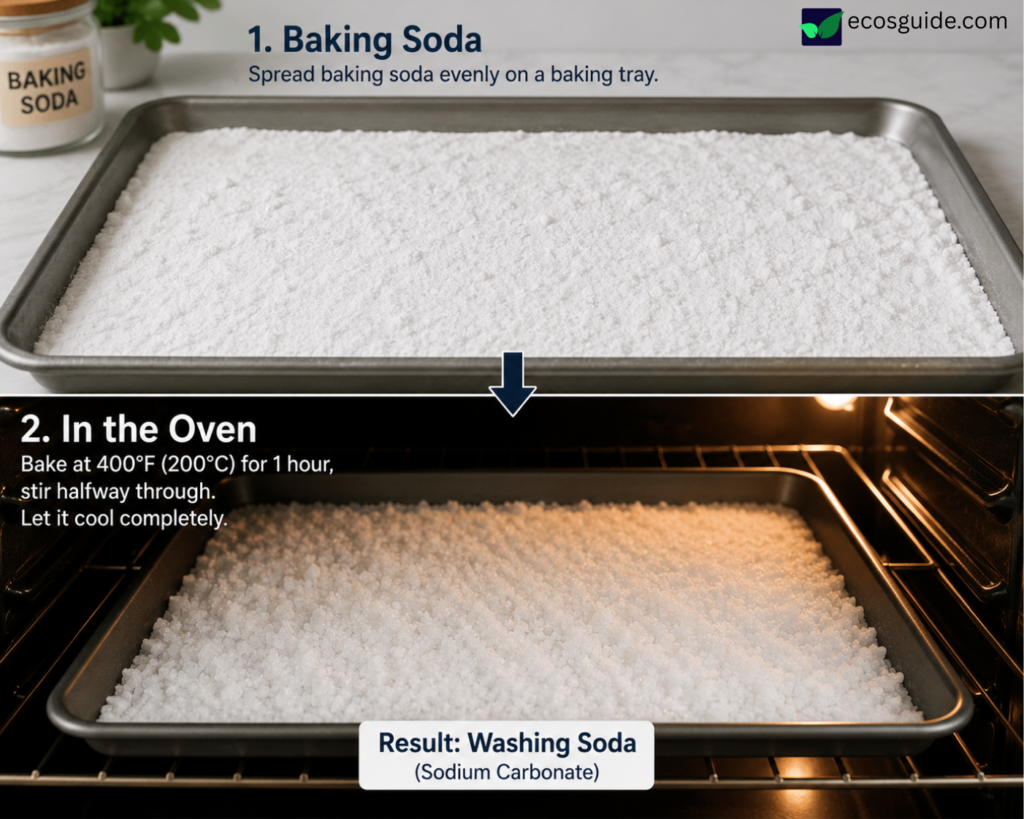
You can turn baking soda into washing soda at home by baking it at 400°F (200°C) for 30 to 60 minutes, which drives off water and carbon dioxide and leaves sodium carbonate behind.
Spread it in a thin layer on a baking tray, and you will see the texture shift from soft and powdery to coarse and grainy. That visible change is the chemistry happening right in front of you.
For everyday jobs, though, the box most of us already have is plain baking soda, and a large box of Arm & Hammer Pure Baking Soda lasts a long time for deodorizing, gentle scrubbing, and the occasional oven-conversion experiment.
Which One Should I Use in My Kitchen?
This is where most guides stop short, because they treat washing soda as a laundry product and forget the kitchen entirely.
The short version: reach for baking soda for gentle, everyday cleaning, and save washing soda for the heavy, greasy jobs where its strength is worth the extra care.
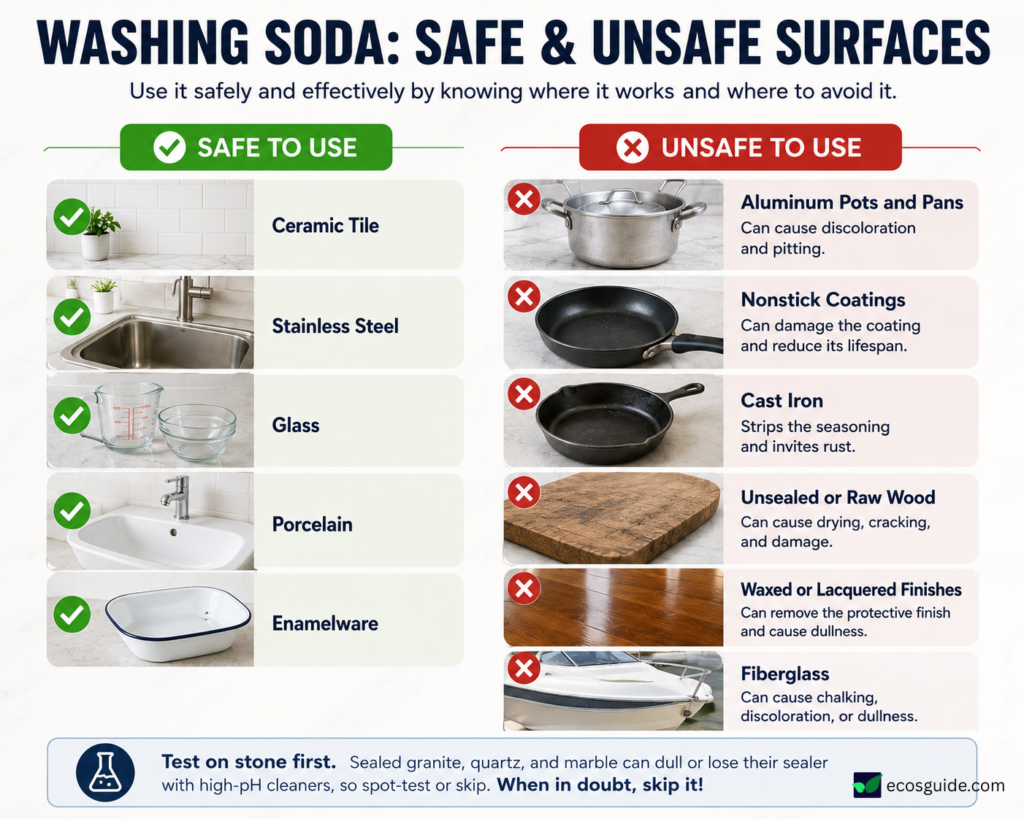
Washing soda should never be used on aluminum, nonstick coatings, or unsealed wood, because its high alkalinity can corrode, dull, or damage those surfaces. Keep it off:
- Aluminum pots and pans
- Nonstick coatings
- Unsealed or raw wood
- Waxed or lacquered finishes
- Fiberglass
Baking soda is far more forgiving. It is safe on most sealed surfaces, stainless steel, and sinks, though I use a soft hand on glossy glass cooktops, since even a mild powder is still abrasive.
So how does this map to real appliances and pans? For deodorizing and light scrubbing, baking soda is my default.
For baked-on grease, washing soda or the bake-your-own route does the job faster. When something is truly stuck to a pan, our full burnt-pan method walks through the gentle way I tackle it.
For a greasy stovetop, the same logic applies to cleaning a greasy gas stove top. And when the problem is mineral buildup rather than grease, that is a different job, closer to descaling a stainless steel kettle.
Is Baking Soda the Same as Borax?
No, borax is a third, separate powder, and it is easy to lump in with the other two because it also comes as a white crystalline cleaner.
But it is chemically different and sits at its own strength level.
Borax (sodium tetraborate) is a third, distinct powder with a pH of about 9.5, between baking soda and washing soda.
It is an effective cleaner and laundry booster, but it is not food-safe and should be kept away from children and pets.
If you line the three up by strength, it runs baking soda first (mildest), then borax, then washing soda (strongest).
Borax is good at boosting laundry detergent, softening water, and tackling grime, but the safety note matters more here than it does with baking soda.
According to PubChem’s sodium tetraborate record, swallowing it can cause stomach upset, and the fine dust can irritate the lungs, so it is worth storing well out of reach.
If you do keep borax on hand, a box like 20 Mule Team Borax is the common option.
I haven’t tested this one in my own kitchen, but based on its ingredients and the reviews from eco-minded buyers, it checks the right boxes.
Just treat it with the same care you would give any cleaner that is not meant to be eaten.
Bicarbonate of Soda, Soda Crystals, Soda Ash, and Baking Powder Explained
Half the confusion here comes down to names, especially between the US and the UK.
In the UK, baking soda is sold as bicarbonate of soda, and washing soda is sold as soda crystals or soda ash; baking powder is a different product and cannot replace either.
So if a British recipe or cleaning tip mentions bicarbonate of soda, that is simply baking soda under another name, and soda crystals are washing soda.
The one that trips people up most is baking powder. Baking powder is not the same as baking soda: it is baking soda combined with a dry acid and a starch, designed for baking rather than cleaning.
Because it already contains an acid, it does not behave like pure baking soda in a cleaning paste, and it is not a substitute for washing soda at all.
When a recipe or a cleaning method calls for one of these powders, the name really does matter, so it is worth a second look before you scoop.
Are They Actually Eco-Friendly?
Mostly, yes, and this is the part I care about most.
Both baking soda and washing soda are simpler, gentler choices for waterways than many conventional cleaners loaded with phosphates and synthetic surfactants.
Baking soda and washing soda are simple mineral salts that break down into common, naturally occurring ions rather than persisting like many synthetic cleaning chemicals, which makes them gentler on rivers and aquatic life.
The EPA’s Safer Choice program is a helpful way to see how ingredient safety and aquatic toxicity are actually judged.
That said, natural does not mean unlimited. Washing soda raises water alkalinity, so it is a heavier load on the drain than baking soda, and borax is more ecologically debated because of its boron content.
In moderation, all three are fine for most septic systems, but gentle still means using a sensible amount.
One myth worth clearing up is mixing baking soda and vinegar.
Mixing baking soda and vinegar mostly cancels both out, because the acid and base neutralize each other into water, carbon dioxide, and a little salt, so the dramatic fizz is not a powerful cleaner or germ-killer.
For everyday dishes, I would rather reach for a gentler dish soap that’s kinder to drains and let baking soda do what it does best on its own.
Final Thought
So, is baking soda the same as washing soda? No, and now you know exactly how they differ, when to swap one for the other, and which one belongs in your kitchen versus your laundry.
Baking soda is your gentle, food-safe everyday helper. Washing soda is the heavy hitter you bring out with care, and borax is its own separate thing entirely.
Next time something is baked onto a pan, here is the gentle way I tackle it with our full burnt-pan method, no harsh chemicals required.
- What’s the Actual Difference Between Baking Soda and Washing Soda?
- Can I Use One Instead of the Other?
- Which One Should I Use in My Kitchen?
- Is Baking Soda the Same as Borax?
- Bicarbonate of Soda, Soda Crystals, Soda Ash, and Baking Powder Explained
- Are They Actually Eco-Friendly?
- Final Thought
- Frequently Asked Questions
Find More Tips At:


Frequently Asked Questions
Can I substitute baking soda for washing soda?
Yes for cleaning, but it will work more weakly, since baking soda is far less alkaline. Never do it the other way around in food or recipes, because washing soda is caustic and not edible. If you need washing soda’s strength, you can bake baking soda at 400°F (200°C) for 30 to 60 minutes to convert it.
Is washing soda safe to use on aluminum pans?
No. Washing soda’s high alkalinity can corrode and dull aluminum, and it can also damage nonstick coatings and unsealed wood. If you use it for heavy grease, wear gloves and keep it to surfaces like sealed steel or enamel that can handle it.
Is washing soda the same as soda ash or soda crystals?
Yes. Soda ash and soda crystals are both names for sodium carbonate, which is washing soda. In the UK in particular, washing soda is usually sold as soda crystals, so if a British cleaning tip mentions them, it means the same thing.
Is baking soda the same as borax?
No. Borax is sodium tetraborate, a separate powder that is stronger than baking soda and sits between baking soda and washing soda in alkalinity. It is a useful cleaner and laundry booster, but unlike baking soda it is not food-safe and should be kept away from children and pets.
Is baking soda the same as baking powder?
No. Baking powder is baking soda combined with a dry acid and a starch, made for baking rather than cleaning. It will not work as a cleaning substitute for washing soda, and it behaves differently from plain baking soda in a paste.
Is washing soda bad for the environment or a septic system?
In moderation, washing soda is generally fine and gentler on waterways than phosphate or surfactant-heavy cleaners. It does raise water alkalinity, though, so it is a heavier load than baking soda, and natural does not mean you can use unlimited amounts. For most septic systems, sensible use is not a problem.
